
Wheel Balancing After Rim Repair: What You Need to Know
If you have just had a bent or kerbed rim straightened, there is one question we hear almost every day at our Parow workshop: do I really need wheel balancing after a rim repair? The short answer is yes — wheel balancing after rim repair is not an optional extra, it is the step that actually makes the repair usable at highway speed. A rim can be pulled back into perfect shape and still shake the car apart at 120 km/h if it is not rebalanced afterwards. Skipping it is the single most common reason drivers phone us a week later complaining that "the repair didn't work."
This guide explains exactly why a repaired rim always needs rebalancing, the difference between static and dynamic balance, what it costs in South Africa, and what happens if you drive off without it.
Do You Need Wheel Balancing After a Rim Repair?
Yes. Any time a wheel and tyre assembly is broken apart, reshaped, or refitted, the weight distribution around the wheel changes — and balance is entirely about weight distribution. When we straighten a buckled rim, weld a crack, or refinish an alloy, the tyre has to come off the rim and go back on afterwards. That single act of demounting and remounting the tyre already means the old wheel weights are gone and the tyre may seat in a slightly different position. Add the metal that was moved during straightening and you have a wheel that is guaranteed to be out of balance.
Think of it this way: a wheel spinning at open-road speed rotates roughly 800 times a minute. A weight imbalance of just 10 to 15 grams — lighter than a R5 coin — is enough to produce a noticeable vibration through the steering wheel or seat. That is why we treat balancing as part of the repair, not a separate favour. If someone offers to straighten your rim and hands it back without balancing, the job is half finished.
Why a Repaired Rim Throws Off the Balance
There are three reasons a repaired wheel is almost always out of balance until it goes on the balancer:
- The tyre was removed and refitted. To straighten or weld a rim safely, the tyre must come off. When it goes back on, the bead seats in a fresh position and the heavy spot of the tyre no longer lines up with wherever it sat before.
- Metal moved during straightening. Rim straightening uses heat and pressure to push aluminium back into shape. Even a millimetre of correction shifts a small amount of mass around the wheel.
- The old wheel weights are gone. The stick-on or clip-on weights that balanced the wheel originally are removed before any repair. They cannot simply be stuck back in the same place, because the balance point has changed.
None of this means the repair was done badly. It is simply physics — you cannot reshape a spinning object and expect its balance to be untouched. That is exactly why every reputable shop finishes a straightening or bent rim repair on a balancing machine before the wheel goes back on your car.
Static vs Dynamic Balancing Explained
When people ask about balancing, they usually picture a machine adding little weights to a rim. But there are actually two kinds of imbalance, and a good repair corrects both.
Static balance
Static (or "single-plane") imbalance is the simple one: one part of the wheel is heavier than the rest. Left uncorrected, this makes the wheel hop up and down — you feel it as an up-and-down bounce through the steering, worst at a specific speed. Static balancing corrects weight around the circumference of the wheel so no single spot is heavier than another.
Dynamic balance
Dynamic ("two-plane") imbalance is more subtle. Here the weight is uneven across the width of the wheel — heavier on the inner edge than the outer, or vice versa. This makes the wheel wobble side to side, which you feel as a shimmy or shudder rather than a bounce. Correcting it needs weights on both the inner and outer rim faces.
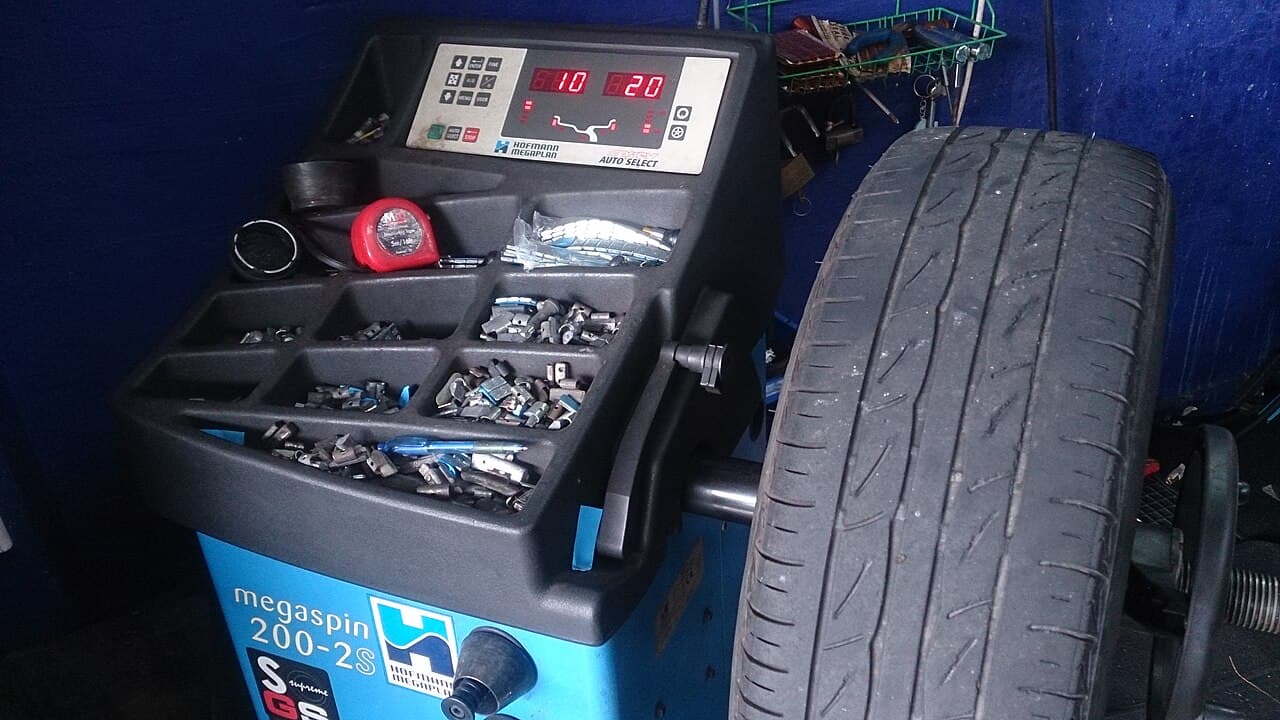
A modern spin balancer, like the machine in the photo above, measures both at once. It spins the wheel at speed, reads exactly where and how much weight is needed on each plane, and tells the technician precisely where to place the weights. This is why "balancing by eye" or a cheap bubble balancer is not good enough after a repair — a bubble balancer only catches static imbalance and misses the dynamic wobble entirely.
What Happens If You Skip Balancing After a Repair
Driving on a repaired-but-unbalanced wheel is not just uncomfortable — it is expensive. Here is what an out-of-balance wheel does over time:
- Vibration at speed. The classic symptom. A shudder through the steering wheel between roughly 90 and 120 km/h is almost always a balance problem. We cover the full list of causes in our guide to wheel vibration at high speed, but after a repair, balance is the first suspect.
- Uneven, accelerated tyre wear. An unbalanced wheel scrubs and bounces against the road, wearing the tread in patches. You can lose thousands of kilometres of tyre life and end up buying rubber far sooner than you should.
- Premature wear on suspension and steering. That constant vibration is not free energy — it hammers your wheel bearings, tie-rod ends, and shock absorbers. On our pothole-ravaged Cape Town roads those parts already take a beating; an unbalanced wheel just speeds up the damage.
- The repair gets blamed unfairly. Nine times out of ten, when someone says "the rim straightening didn't hold," the rim is fine — the wheel simply was never balanced. The vibration they feel is imbalance, not a failed repair.
In short, skipping the balance undoes the value of the repair and quietly damages other, more expensive parts of the car.
How Wheel Balancing Works: The Process
At Speedline Mags, balancing is the final quality-control step before a repaired wheel leaves the shop. The process is quick but precise:
- The wheel-and-tyre assembly is mounted on the balancer's shaft and clamped dead-centre.
- The machine spins the wheel up to speed and uses sensors to measure imbalance on both the inner and outer planes.
- The display shows exactly how many grams of weight are needed and precisely where to place them — inner face, outer face, or both.
- The technician fits the correct clip-on or adhesive weights. On alloys and diamond-cut finishes we use discreet stick-on weights on the inside of the rim so they are invisible and don't mark the face.
- The wheel is spun again to confirm it reads zero on both planes. If it doesn't, we adjust and re-spin until it does.
The whole thing takes only a few minutes per wheel, but it is the step that turns a straightened rim into one you can trust on the N1.
What Does Wheel Balancing Cost in South Africa?
Balancing is one of the most affordable services in the whole wheel-care world. As a standalone job in South Africa, expect to pay roughly R60 to R120 per wheel in 2026, depending on the shop, the wheel size, and whether new weights are needed. Larger 19-inch and 20-inch performance wheels tend to sit at the top of that range because they need more weight and finer adjustment.
Here is the important part for anyone who has just had a rim fixed: when balancing is done as part of a straightening or refinishing job, most reputable shops include it in the repair price rather than charging it separately. It is simply part of doing the job properly. When you compare quotes, always ask whether balancing is included — a "cheaper" repair that leaves balancing off is not actually cheaper once you drive to a tyre shop to have it done. For a full breakdown of what wheel work costs locally, see our mag repair price guide for South Africa.
Balancing vs Alignment: Don't Confuse the Two
This trips a lot of people up, so it is worth being clear. Balancing and alignment are completely different jobs that solve different problems:
- Balancing corrects weight distribution within the wheel and tyre. It fixes vibration. It is always needed after a rim repair.
- Alignment adjusts the angles at which the wheels sit relative to the road and each other. It fixes pulling to one side and uneven tyre wear caused by geometry, not weight.
A rim repair on its own does not require an alignment — unless the impact that bent your rim also knocked the suspension geometry out, which can happen with a hard pothole strike. If your car pulls to one side after hitting something, get the alignment checked too. We explain the full difference in our guide to wheel alignment versus wheel balancing. For a repaired rim, though, balancing is the non-negotiable step; alignment is situational.
When to Rebalance Beyond Repairs
Rim repair is the obvious trigger, but it is not the only time your wheels need rebalancing. Book a balance whenever you:
- Fit new tyres or rotate your existing ones.
- Notice a vibration that develops gradually — weights can fall off, especially after hitting a kerb or pothole.
- Have a tyre repaired or a puncture plugged, since the tyre comes off the rim.
- Are prepping for a long trip on the open road.
Making balancing a routine habit is part of good post-repair wheel care in the first few weeks and general wheel maintenance. Wheels are the one part of your car in constant, high-speed rotation — keeping them balanced protects everything connected to them.
Getting It Done Right in Cape Town
Not every workshop that straightens rims finishes the job on a proper spin balancer, and not every tyre shop that balances wheels can straighten a buckled alloy. At Speedline Mags in Parow, we do both under one roof, so your repaired rim is balanced, checked, and road-ready before it goes back on your car — no second trip, no surprise vibration on the way home.
We are a short drive from Bellville, Goodwood, Monte Vista, and the wider Northern Suburbs, and drivers from across Cape Town bring us everything from VW Polos and Toyota Hiluxes to BMWs and Audis. If you are local to the area, our Parow and Goodwood wheel repair page has directions and service details.
Conclusion
So, do you need wheel balancing after a rim repair? Absolutely — it is the step that makes the repair actually work. Straightening or welding a rim moves metal and forces the tyre off and back on, which guarantees the wheel is out of balance until it goes on the balancer. Correcting both the static and dynamic imbalance is what stops the vibration, saves your tyres, and protects your suspension. It is quick, it is affordable at around R60 to R120 a wheel, and at a proper shop it is simply part of the repair.
If your car has developed a shimmy after a repair, or you have a bent rim that needs both straightening and balancing done right the first time, get in touch with the Speedline Mags team in Parow, Cape Town. We will make sure your wheels leave perfectly round and perfectly balanced — call or WhatsApp us today for a quick, honest quote.