
Rim Straightening: What It Is, How Long It Takes & What It Costs
South African roads can be brutal on your wheels. Whether it's a hidden pothole on the N1, a nasty kerb kiss in a Bellville parking lot, or a rough patch of gravel on a Cape Winelands back road — bent rims are a very common problem for Cape Town drivers. The good news? In most cases, rim straightening can restore your wheel to factory spec without the hefty cost of a full replacement.
This guide covers everything you need to know about rim straightening: what the process involves, how long it takes, what it costs, and — critically — when it simply isn't safe to straighten a wheel.
What Is Rim Straightening?
Rim straightening (also called wheel straightening or bent rim repair) is the process of restoring a deformed alloy or steel wheel back to its original, true circular shape. When a wheel takes a hard impact — a pothole, a speed bump hit too fast, a kerb strike — the metal can deform. The result is a bent, buckled, or out-of-round rim that causes vibrations, uneven tyre wear, and in some cases, a slow or rapid loss of tyre pressure.
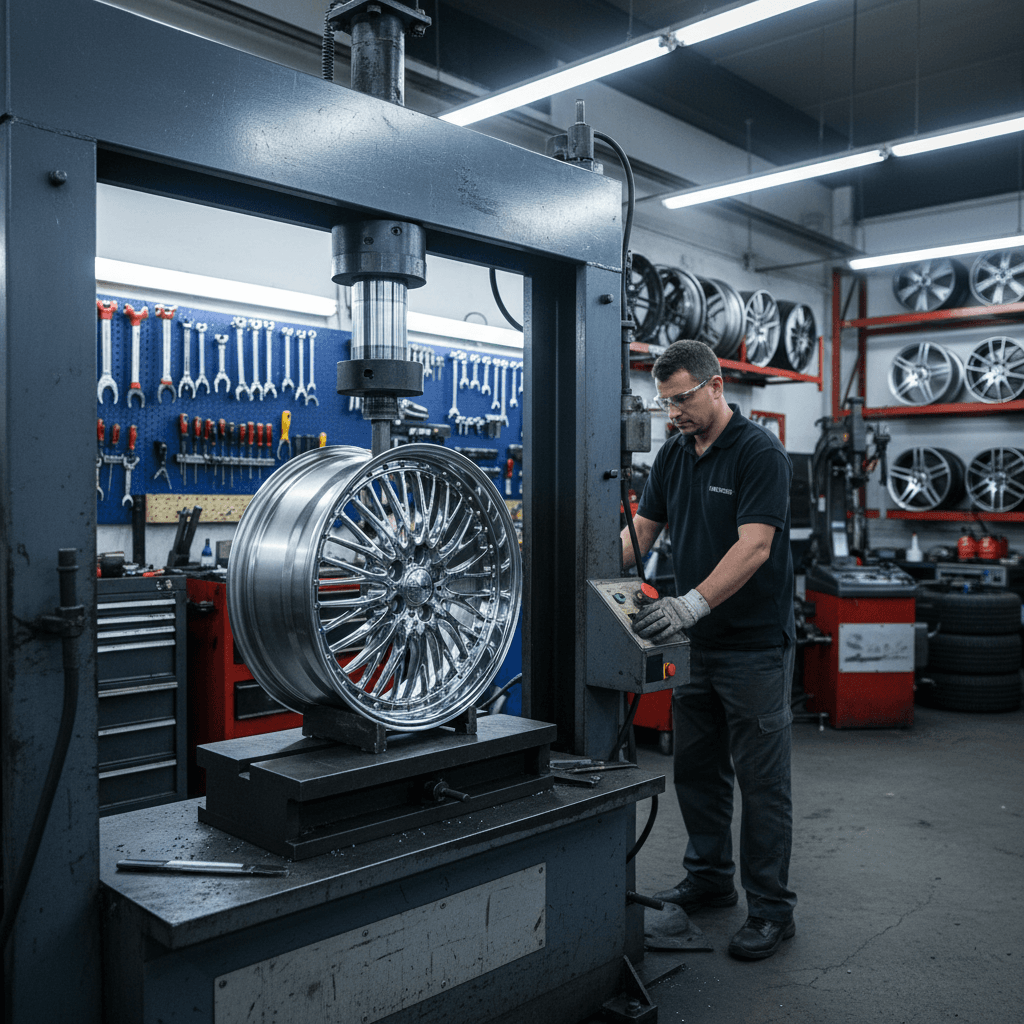
Modern rim straightening is done using a hydraulic press machine — a precision piece of workshop equipment that applies controlled, measured force to the damaged section of the wheel. Unlike old-school hammer-and-anvil methods, a hydraulic press allows a skilled technician to reshape the wheel gradually and accurately, monitoring the process with run-out gauges to confirm the wheel returns to within tolerance.
There are two main types of damage the process addresses:
- Lateral (side-to-side) buckle — the wheel wobbles left and right when spinning. Often caused by a hard sidewall impact.
- Radial (up-and-down) buckle — the wheel bounces up and down. Typically caused by a direct face-on impact, like hitting a pothole straight on.
Both types can be corrected by straightening, though radial buckles tend to be slightly more involved to repair.
How the Hydraulic Press Process Works
The rim straightening process at a reputable workshop like Speedline Mags in Parow follows a structured sequence:
1. Assessment and Run-Out Check
Before any pressing begins, the wheel is mounted on a balancing or run-out machine and measured. A dial indicator (or electronic sensor) records exactly how far out of true the wheel is — measured in millimetres. This gives the technician a precise baseline and helps them decide whether straightening is viable.
Industry safety thresholds typically consider a wheel viable for straightening if the deformation is within a certain range (more on safety limits below). If the wheel is cracked, severely deformed, or the bead seat is compromised, straightening won't be recommended.
2. Heating (Where Required)
For some alloy types — particularly cast alloys — the affected area is carefully heated to make the metal more malleable before pressing. This reduces the risk of cracking the alloy during the reshaping process. The heating is done with precision; over-heating weakens the metal's structure, so this step requires experience and care.
3. Hydraulic Press Straightening
The wheel is secured in the press fixture, and the technician applies controlled hydraulic pressure to the deformed section. This is done in stages — a little at a time — rather than one aggressive push. Between each press cycle, the wheel is re-measured to track progress.
This iterative press-and-measure approach is what separates quality rim straightening from quick-fix operations. Rushing this step can over-correct the deformation or introduce new stress points.
4. Final Run-Out Verification
Once the pressing is complete, the wheel is measured again to confirm it's within acceptable tolerances. At Speedline Mags, we use a strict run-out standard — the wheel needs to be within tolerance before it leaves the workshop.
5. Optional Refinishing
If the wheel sustained cosmetic damage alongside the buckle — scuffed paint, kerb rash, or flaking lacquer — straightening can be combined with a refurbishment. Powder coating or diamond cut refurbishment can be done on the same visit, saving you time and money.
How Long Does Rim Straightening Take?
For a single wheel with no cosmetic work, rim straightening typically takes 1 to 3 hours at a specialist workshop. That said, turnaround time depends on several factors:
- Severity of the damage — a minor buckle takes less time than a severe deformation requiring multiple press cycles
- Alloy type — some alloys require more careful, staged pressing
- Workshop queue — walk-in or same-day slots may be available; some customers prefer to book ahead
At Speedline Mags, most rim straightening jobs are completed same-day. If you're combining straightening with powder coating or a full refurbishment, allow 2 to 4 days for the complete process, as coating and curing time is needed.
If you're unsure whether your wheel can be straightened the same day, call ahead — it helps to describe the damage and share a photo so the team can assess it before your arrival.
What Does Rim Straightening Cost in South Africa?
Rim straightening cost in South Africa varies based on wheel size, alloy type, and the extent of the damage. As a guide for 2026:
| Wheel Size | Typical Price Range (ZAR) | |---|---| | 15–16 inch | R350 – R600 per wheel | | 17–18 inch | R500 – R800 per wheel | | 19–20 inch | R700 – R1,100 per wheel | | 21 inch and above | R1,000 – R1,500+ per wheel |
These are indicative prices — final pricing depends on the specific damage and your wheel type. Premium alloys with complex designs (multi-spoke, hollow spoke) may cost more due to the time and care required in the pressing process.
Compare this to replacement cost: a quality OEM or aftermarket alloy for a common South African vehicle like a VW Polo, Toyota Hilux, or BMW 3 Series typically costs anywhere from R2,000 to R8,000+ per wheel. Straightening, in most cases, is a fraction of that cost.
For more detail on the broader landscape of repair pricing, see our wheel repair cost guide for South Africa.
When Is Rim Straightening NOT Recommended?
This is the most important section of this guide — and one that less reputable workshops sometimes gloss over.
Rim straightening is not always the right answer. There are clear situations where a wheel should not be straightened and should instead be replaced:
Cracks or Fractures
If the wheel has any visible cracks — even hairline cracks — it should not be straightened. The pressing process puts additional stress on the metal, and a cracked wheel can catastrophically fail under load. A cracked alloy wheel is a safety risk on the road, full stop. Always consider whether repair or replacement is the right call.
Bead Seat Damage
The bead seat is the area of the rim that the tyre seals against. If this section is significantly bent or deformed, a proper seal between tyre and rim may not be achievable even after straightening — leading to slow leaks or tyre dismount at speed.
Severe Deformation
If the rim is bent to the point where the spokes, inner barrel, or flange are grossly distorted, the structural integrity may be compromised even if it can be pressed back to shape. A reputable technician will advise against straightening wheels that exceed safe deformation limits.
Repeated Repairs
A wheel that has been straightened multiple times has undergone cumulative stress. At some point, the metal fatigue makes the wheel unsafe regardless of visual appearance. A good workshop tracks this and will recommend replacement when a wheel has reached the end of its serviceable life.
At Speedline Mags, we won't straighten a wheel we're not confident in. If we assess a wheel and determine it's unsafe to repair, we'll tell you clearly — and we can advise on replacement options if needed.
Signs You May Need Rim Straightening
Not sure if your rim is bent? Here are the common symptoms to watch for:
- Steering wheel vibration — particularly at highway speeds (80–120 km/h). A buckled rim causes an imbalance that the steering column transmits directly to your hands.
- Rhythmic thumping or bumping — felt through the seat or floor, especially at lower speeds, can indicate a radial buckle.
- Uneven tyre wear — a bent rim changes the way the tyre sits and rolls, leading to faster or irregular wear.
- Slow tyre pressure loss — if one tyre keeps losing pressure despite no puncture, a damaged bead seat from rim impact may be the cause.
- Car pulling to one side — while this can also be a wheel alignment issue, a bent rim can contribute to the car drifting.
If you're experiencing any of these, it's worth having your wheels inspected sooner rather than later. Driving on a bent rim accelerates tyre wear and can damage wheel bearings over time. For a broader look at warning signs, see our guide on signs your wheels need professional repair.
Rim Straightening vs Wheel Balancing: Understanding the Difference
These are two distinct services that are sometimes confused:
Wheel balancing corrects uneven weight distribution around a wheel and tyre assembly. It's done with balance weights applied to the rim and addresses vibrations caused by weight imbalance — not physical deformation.
Rim straightening corrects physical deformation of the wheel itself. Even after straightening, a wheel should be balanced, since the pressing process can slightly shift the weight distribution.
If your workshop only offers balancing for a vibration issue and hasn't checked for a physical buckle, it's worth asking them to check wheel run-out as well. For more on the distinction, our wheel alignment vs balancing guide covers related concepts.
Rim Straightening at Speedline Mags, Parow
Speedline Mags is a specialist wheel repair workshop based in Parow, Cape Town, serving customers across the Northern Suburbs — Bellville, Durbanville, Goodwood, Brackenfell — as well as the Southern Suburbs and Atlantic Seaboard.
We use professional hydraulic press equipment and experienced technicians who have worked on everything from standard steel rims on commuter vehicles to high-end alloys on German performance cars. Whether you drive a Hilux bakkie, a VW Polo, an Audi Q5, or a Mercedes-Benz GLC, our team has the experience to assess and repair your wheels correctly.
Our process is always transparent:
- Free visual assessment before any work begins
- Clear communication if a wheel cannot be safely straightened
- Same-day turnaround for most straightening jobs
- Option to combine with refinishing for a full repair in one visit
We also offer wheel refurbishment and powder coating, diamond cut restoration, and kerb rash repair — so if your wheel needs more than just straightening, we can handle the full job.
Frequently Asked Questions
Can a bent alloy wheel always be straightened? No. Whether a wheel can be safely straightened depends on the type and severity of the damage. Cracked wheels, severely deformed wheels, or wheels with bead seat damage should be replaced. A proper assessment is always the first step.
Will straightening affect my wheel's strength? When done correctly by an experienced technician on a suitable wheel, straightening does not significantly compromise strength. Improper straightening — too much heat, too aggressive pressing — can weaken the metal. This is why choosing a reputable specialist matters.
Is rim straightening covered by insurance? In some cases, yes — particularly if the damage was caused by a pothole or road incident and you have comprehensive cover. Our insurance claims guide walks through how the process works in South Africa.
Can I drive on a bent rim? We advise against it, especially at highway speeds. A bent rim causes vibration, uneven tyre wear, and in severe cases, tyre deflation. If you suspect a bent rim, have it assessed as soon as possible.
Summary
Rim straightening is one of the most cost-effective wheel repairs available — restoring a bent alloy to safe, driveable condition for a fraction of replacement cost. The process uses a hydraulic press and precision measurement to reshape the wheel back to factory spec. Most jobs are completed same-day, and costs typically range from R350 to R1,500 depending on wheel size and damage extent.
That said, straightening isn't always the answer. Cracked wheels, severely deformed rims, and wheels with bead seat damage should be replaced — and a trustworthy workshop will always tell you the truth about what your wheel needs.
Need your rim assessed? Contact Speedline Mags in Parow, Cape Town. We'll give you an honest evaluation and a clear quote — no pressure, just straight talk about your wheels.
Get in touch with Speedline Mags or visit us in Parow for a free rim inspection.