
Bent Rim Repair: When Is a Buckled Wheel Fixable?
South Africa's roads are unforgiving. Between Cape Town's pothole-riddled streets, speed bumps that appear out of nowhere, and the odd kerb encounter, it's only a matter of time before most drivers experience a bent or buckled rim. The question that follows is always the same: is bent rim repair possible, or do I need a new wheel?
The answer depends on several factors — the type of alloy, the severity of the damage, the wheel's position on the car, and what the repair process will actually look like. This guide walks you through everything you need to know.
What Causes a Rim to Bend?
Bending typically happens in one of three ways:
Potholes are the leading cause in South Africa. A sharp-edged pothole at speed creates an intense impact force. The tyre absorbs some of it, but if the tyre pressure is low or the pothole is deep, the rim takes the full hit. The alloy deforms along the inner or outer barrel.
Kerbing — clipping a pavement edge during parking — usually causes a more localised buckle or crease on the rim's outer face. It's often combined with cosmetic scuffing.
Speed bumps at speed can cause a similar effect to potholes, particularly on lowered vehicles or those running wider, lower-profile tyres with less sidewall protection.
Overloading is common with bakkies like the Toyota Hilux and Ford Ranger. Regularly running at or beyond load capacity puts constant stress on all four rims, and repeated heavy loading can gradually deform them.
Bent Rim vs Buckled Rim: Is There a Difference?
The terms are often used interchangeably, but there's a practical distinction:
- A bent rim usually refers to lateral deformation — the wheel is no longer perfectly flat when viewed face-on. This causes the characteristic vibration at speed.
- A buckled rim more often describes radial deformation — the wheel is no longer round, causing a rhythmic up-and-down motion felt in the steering wheel or seat.
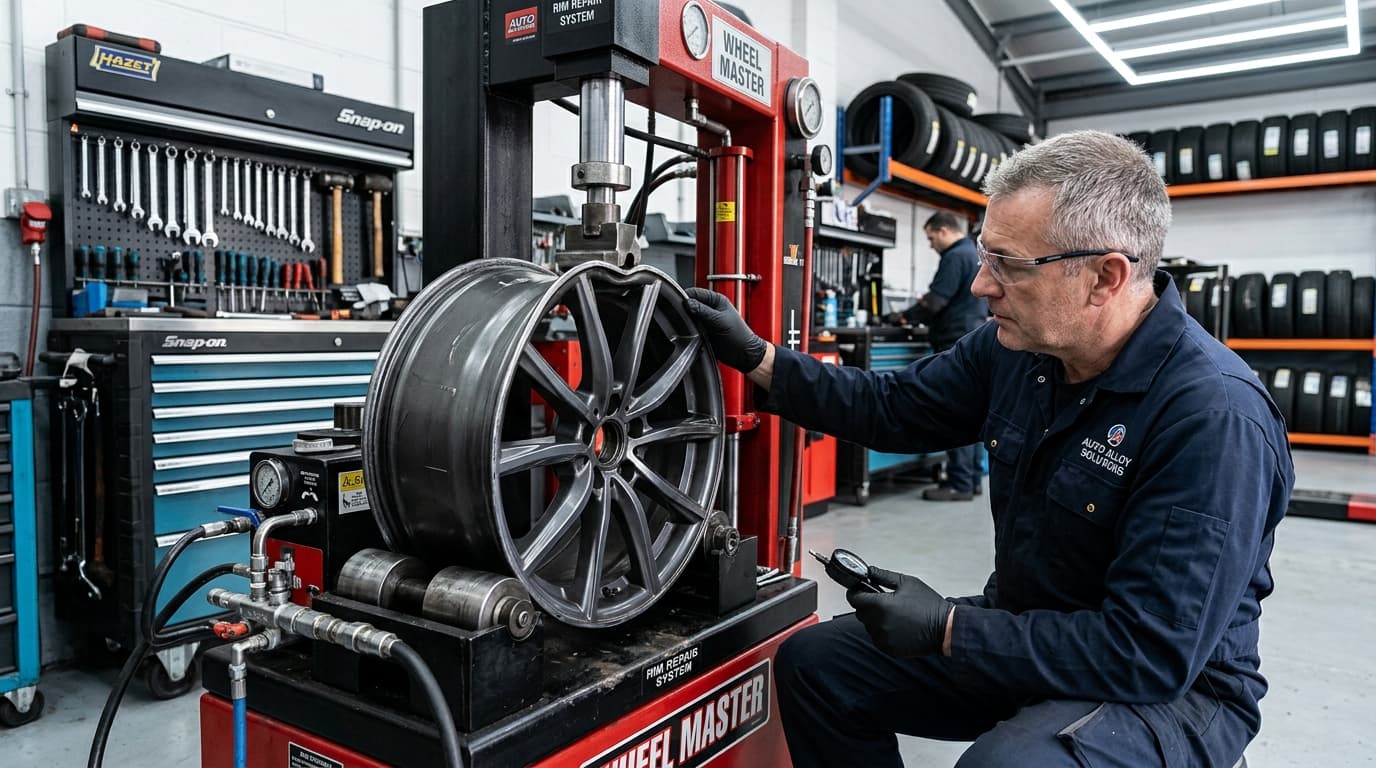
In practice, both can occur together after a significant impact, and both are addressable through wheel straightening — a process that uses hydraulic presses to restore the original geometry.
Can a Bent Rim Always Be Repaired?
Not always. Whether bent rim repair is viable depends on the following:
1. Severity of the Damage
Minor to moderate deformation is almost always repairable. If the wheel is bent badly enough to cause visible wobble at low speed, or if the rim has cracked, the calculus changes.
A small crack doesn't automatically mean replacement — alloy welding can address some cracks — but cracks near the spoke roots or across the barrel are structurally critical and generally warrant replacement rather than repair. Safety must come first.
2. Alloy Composition
Cast alloys, which make up the majority of standard-fitment wheels on cars like the VW Polo, Hyundai i20, and Toyota Corolla, respond well to heat-assisted straightening. They're designed to be somewhat malleable.
Forged alloys — found on performance vehicles and high-end fitments — are denser and stronger, which makes them more resistant to bending in the first place, but also more brittle during the repair process. A forged alloy that has been significantly bent requires specialist assessment.
3. Previous Repairs
A wheel that has been straightened once can usually be straightened again, provided the metal hasn't been work-hardened to the point of brittleness. However, a wheel with multiple repair sites, or one that has been repaired and re-damaged repeatedly, may be compromised enough that replacement is the better call.
4. Wheel Position
Front wheels bear the brunt of steering loads and braking forces. A front wheel that has been straightened should be carefully inspected for hairline cracks before being returned to service. Rear wheels on non-driven axles are generally subject to less stress.
The Bent Rim Repair Process
At Speedline Mags in Parow, the process for assessing and repairing a bent rim follows a consistent sequence:
Initial inspection: The wheel is mounted on a precision run-out gauge that measures both radial (up/down) and lateral (side-to-side) deviation. This gives an exact measurement of how far out of true the wheel is.
Damage assessment: We look for cracks, previous welds, and the location of the deformation relative to the spokes and bolt holes. This determines whether the wheel is a candidate for straightening.
Hydraulic straightening: Using a hydraulic wheel press with purpose-built tooling, the deformed section is carefully pressed back into shape. For aluminium alloys, controlled heating may be used to reduce the risk of cracking during the process. The goal is to bring radial and lateral run-out within manufacturer tolerances — typically under 1mm.
Post-repair inspection: The wheel is re-checked on the run-out gauge and visually inspected for stress fractures introduced during straightening.
Refinishing (if required): If the cosmetic finish was damaged, we can powder coat or diamond cut the wheel after straightening, returning it to showroom condition.
How to Know If Your Rim Is Bent: Warning Signs
Not everyone notices a bent rim immediately. Here's what to look for:
- Vibration through the steering wheel at specific speeds (typically 80–120 km/h) that wasn't there before
- Pulling to one side on a straight, flat road (though this can also indicate alignment or tyre issues)
- Visible wobble when watching the wheel rotate at slow speed — park on a slope and push the car slowly
- Tyre losing pressure repeatedly on the same corner — a bent rim can break the bead seal
- Uneven tyre wear on one wheel compared to others
If you notice any of these after hitting a pothole or kerb, it's worth having the wheel checked before the damage compounds. A slightly bent rim puts extra stress on wheel bearings and suspension components over time.
Bent Rim Repair Cost in Cape Town
Straightening a bent or buckled rim at a specialist workshop in Cape Town typically ranges from R350 to R800 per wheel, depending on the severity of the bend and the wheel size. Larger diameter wheels (19" and above) sit at the higher end of that range.
This compares favourably to replacement cost. A genuine alloy wheel for a VW Polo or Toyota Corolla typically starts from R1,500 to R3,000 or more for OEM fitment — and that's before you factor in balancing and potentially new tyres if the existing ones were damaged.
For context:
| Damage Level | Repair Cost (approx) | Replacement Cost (approx) | |---|---|---| | Minor bend | R350–R500 | R1,500–R3,000+ | | Moderate buckle | R500–R800 | R1,500–R3,000+ | | Severe + cracked | Replace | R1,500–R3,000+ |
For a more detailed breakdown, see our wheel repair cost guide.
When to Replace Instead of Repair
Bent rim repair is not always the right answer. Replace rather than repair if:
- The rim has a visible crack running across the barrel or through a spoke — structural integrity is compromised
- The wheel has been repaired multiple times and is showing signs of metal fatigue
- The deformation is too severe to return to tolerance without excessive material stress
- The wheel is a safety-critical position (front axle, performance vehicle) and the crack risk is elevated
- The cost of repair plus cosmetic refinishing approaches the cost of a good second-hand original wheel
A reputable workshop will tell you honestly when replacement is the better call. At Speedline Mags, if a wheel isn't safe to return to service, we'll say so — even if that means losing the repair job.
Bent Rim Repair vs DIY: What Not to Do
You'll find YouTube videos and forum posts suggesting you can straighten a bent rim at home using a rubber mallet, a blowtorch, and some wishful thinking. For minor cosmetic dents on older steel wheels, this sometimes works. For alloy wheels, it's a different story.
Alloy wheels are load-bearing safety components. Uncontrolled heating and hammering can:
- Introduce micro-cracks not visible to the naked eye
- Work-harden the alloy, making it more prone to catastrophic failure
- Cause the rim to appear straight while being structurally compromised
If that wheel fails at 120 km/h on the N1, the consequences are severe. The R500 saving is not worth it.
Bent Rim Repair for Common Vehicles in Cape Town
Different vehicles tend to experience different failure modes:
VW Polo and Golf — The 16" and 17" alloys on these are among the most commonly repaired at our workshop. They're prone to kerb damage on the outer lip and pothole bends on the inner barrel.
Toyota Hilux — Larger diameter alloys on the Hilux are generally stronger, but overloading combined with rough road conditions can cause gradual deformation. The inner barrel is usually the weak point.
BMW 3 Series — Run-flat tyres fitted to many BMW models have almost no sidewall flex, which means the rim absorbs virtually all pothole impact energy. Front wheel bends are common and the straightening process requires careful handling.
Ford Ranger — Similar to the Hilux, bakkies running 17"–18" alloys in mixed road conditions are susceptible to barrel deformation. See our dedicated Ford Ranger wheel repair guide.
Frequently Asked Questions
Is it safe to drive on a bent rim? Not advisable. A bent rim compromises tyre seating and can cause vibration that accelerates bearing wear. In severe cases, the tyre can unseat at speed. Get it checked promptly.
How long does bent rim repair take? Most standard repairs are completed within a day. Complex cases involving crack repair or full refinishing may take two to three days.
Will my insurance cover it? Comprehensive insurance policies in South Africa may cover pothole damage to wheels, but excesses often make small claims impractical. Check our insurance claims guide for details on how to approach this.
Can a cracked rim be welded? Some cracks can be TIG welded by a specialist and the wheel safely returned to service. Others — particularly cracks through structural areas — cannot. A specialist assessment is required.
Get Your Bent Rim Assessed in Parow
Speedline Mags is based in Parow, Cape Town, serving drivers across the Northern Suburbs including Bellville, Durbanville, Goodwood, and surrounding areas. We offer professional bent rim repair and straightening using precision hydraulic equipment, with honest assessments on every wheel that comes through the door.
If you've hit a pothole and you're feeling that familiar steering-wheel shake, don't wait for the damage to compound. Bring your vehicle in or get in touch to discuss your options — we'll tell you exactly what's repairable, what it will cost, and what the turnaround looks like.
Contact Speedline Mags — your specialist for buckled rim repair, wheel straightening, and alloy wheel refurbishment in Cape Town.