
Wheel Straightening: How Bent Rims Are Fixed
Wheel Straightening: How Bent Rims Are Fixed
A bent alloy rim rarely announces itself with a dramatic crack. More often you get a new steering shake above 90 km/h, a tyre that will not hold pressure overnight, or a rhythmic thump that arrived after one hard pothole on the N1. Wheel straightening bent rim work is the controlled process of measuring that deformity, pushing the alloy back toward true, and verifying that the wheel is still safe to run. Done properly in a Cape Town workshop, it restores ride quality and tyre sealing without forcing you into a full replacement set.
At Speedline Mags in Parow we straighten buckled rims for daily drivers, bakkies and prestige cars from Bellville, Durbanville and across the Northern Suburbs. This guide explains how the repair actually works, what technicians look for before they apply force, when straightening is the wrong call, and what you should expect after the wheel leaves the machine.
What “Bent” Really Means on an Alloy Wheel
Alloy wheels are cast or forged metal discs with tight manufacturing tolerances. When people say a rim is bent, they usually mean one of three related problems:
- Radial runout — the wheel is out of round, so the tyre’s outer edge rises and falls once per revolution
- Lateral runout — the wheel wobbles side to side like a poorly thrown plate
- Local buckle — a short section of the flange or barrel is pushed in or out from a sharp impact
You can have a barely visible lip dent that still ruins high-speed balance, or a clear banana-shaped buckle you can spot with the naked eye. Both matter. The tyre sits on that metal. If the seat is uneven, air escapes, the contact patch pulses, and the steering wheel telegraphs every revolution.
Cape Town roads make this common. Soft winter asphalt, deep rainwater holes, raised manhole edges and shopping-centre speed bumps all deliver short, high-energy hits into low-profile rubber. A VW Polo on 16- or 17-inch alloys, a BMW 3 Series on run-flats, or a Toyota Hilux that clipped a trench at speed can all end up with the same workshop diagnosis: the tyre is fine; the rim is not.
How You Usually Discover a Bent Rim
Most owners do not measure runout at home. They notice symptoms:
Vibration that grows with speed
A classic pattern is a smooth car at 60 km/h and a busy steering wheel at 100–120 km/h. Balance weights can mask a mild buckle for a while. When vibration returns days after a fresh balance, suspect geometry, not only a lost weight. Our guide to wheel vibration at high speed covers the other common causes so you do not chase the wrong fix.
A tyre that slowly loses air
A buckled bead seat can create a path for air even when the tyre, valve and puncture plugs are sound. If soap spray shows bubbles along the rim flange after every inflate, the metal shape may be the leak source. Related reading: slow leak wheel repair.
Uneven tyre wear or a visible wobble on a stand
With the wheel off the car and spun freely, a trained eye can often see a lateral wobble. On the vehicle, cupped or feathered wear on one tyre after a known impact is another clue. For the broader “is this urgent?” checklist, see signs your wheels need professional repair.
Assessment Comes Before Force
Responsible wheel straightening never starts with a hammer. It starts with inspection.
1. Visual and tactile check
Technicians look for cracks at spoke roots, around the hub bore, near the valve hole and along the inner barrel. Paint cracks that follow a sharp crease can hide metal fatigue. Deep gouges from kerbs are cosmetic until they meet a structural fold — then they become part of the risk picture. Kerb strikes and potholes often arrive together; see kerb damage: the most common wheel injury.
2. Crack detection where needed
On questionable rims, dye penetrant or careful magnification helps reveal hairline fractures that ordinary light misses. A crack changes the decision tree immediately. Straightening applies stress. Stress grows cracks. Welding may be possible on some alloys in some locations; many cracked wheels are replace-only for safety.
3. Runout measurement
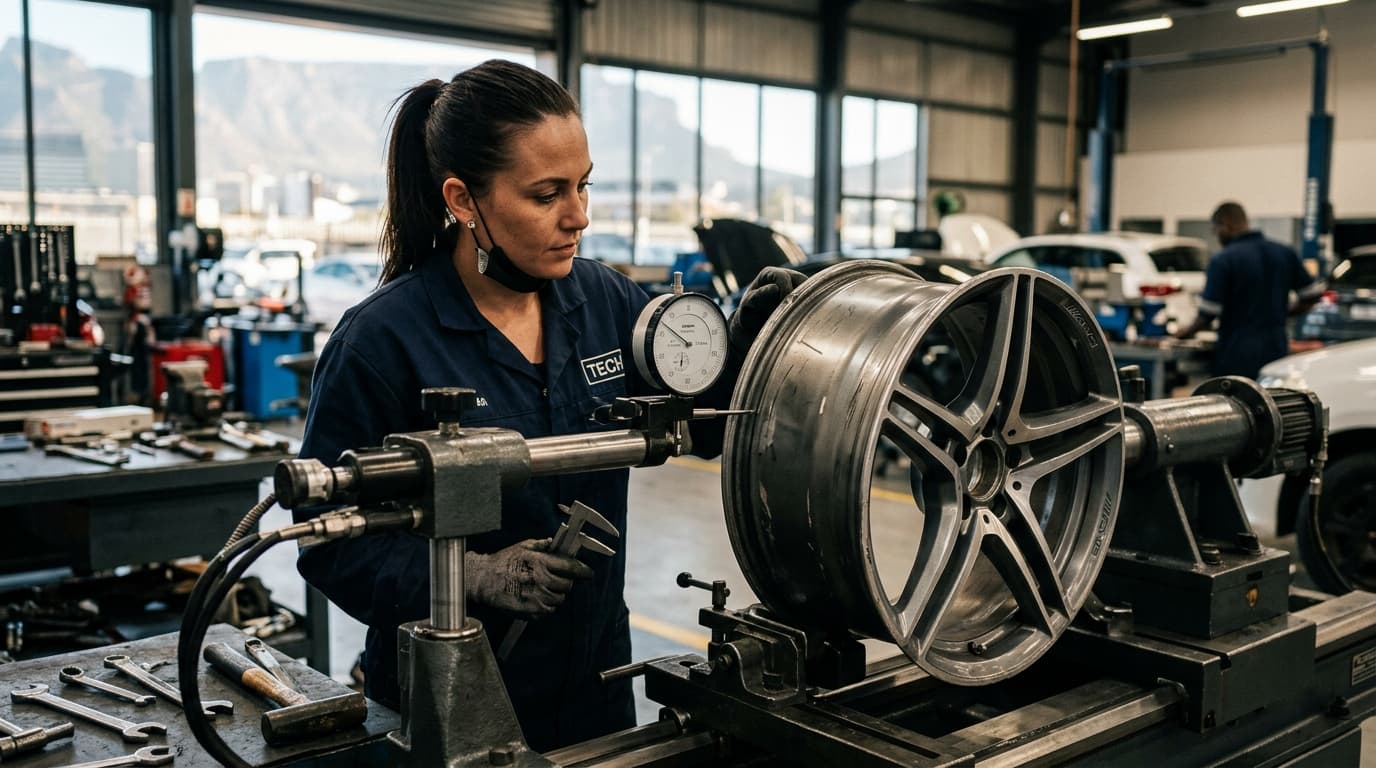
The wheel is mounted on a trueing stand, balancer or dedicated straightening machine with dial indicators or digital probes. Radial and lateral runout are recorded at the flange and sometimes at the barrel. Those numbers decide how much correction is required and whether the buckle is local or global.
4. Material and construction notes
Cast road wheels behave differently from forged motorsport or OEM performance wheels. Thicker barrels tolerate more work. Thin, heavily machined diamond-cut lips can straighten structurally yet still need refinishing because the clear coat fractures during the bend-and-return cycle.
Only after that assessment does a workshop commit to hydraulic correction.
How Bent Rims Are Fixed: The Straightening Process
Different shops use slightly different machines, but the physics is shared: controlled force, incremental movement, constant re-measurement.
Mounting and locating the high/low spots
The rim is clamped so the technician can apply pressure at precise clock positions. Marks show where the dial indicator peaks and troughs. The goal is not to “bash it flat” in one hit. The goal is to reverse the plastic deformation in small steps until runout returns inside a safe tolerance.
Hydraulic and mechanical correction
Hydraulic rams and purpose-built fixtures push or pull the flange and barrel. On some buckles, heat is used carefully to reduce the force needed — always with alloy-appropriate limits, because overheating changes material properties. Cold straightening is preferred where it works; heat is a tool, not a shortcut.
Working the buckle, not the whole wheel
A local pothole crease may need focused pressure on a short arc. A wheel that rolled through a long trench may need correction at several points. Over-correcting one side can throw another section out. That is why the dial indicator stays in play throughout the job.
Recheck, refine, stop at safe tolerance
Technicians re-measure after every meaningful adjustment. Industry practice aims for runout low enough that the tyre can be balanced and the car feels calm at highway speed. Chasing absolute zero on a damaged cast wheel can overwork the metal. Good judgement stops at “true enough and still strong,” not “perfect on paper at any cost.”
Tyre remount, seal check and balance
After straightening, the tyre goes back on (or a new tyre, if the old one was damaged by the same impact). Bead sealing is checked. The wheel is balanced. If the rim was also kerbed or the lacquer cracked, refinishing may follow — powder coat, diamond cut restoration or a targeted lip repair depending on the original finish. For finish choices, compare diamond cut vs powder coating.
What Straightening Can and Cannot Fix
Strong candidates for straightening
- Mild to moderate buckles without cracks
- Local flange dents from potholes or kerbs where the barrel is intact
- Runout that explains vibration after balance and tyre issues are ruled out
- OEM alloys with enough material thickness in the damaged zone
Poor candidates
- Cracked wheels, especially near spokes or the hub
- Severe folds with sharp creases that have already work-hardened badly
- Wheels previously straightened multiple times in the same spot
- Some ultra-lightweight forged designs where the maker specifies replace-only after deformation
- Corrosion so advanced that the bead seat is pitted beyond reliable sealing
When replacement is smarter, a straight conversation beats a heroic repair. Use our wheel repair vs replacement decision guide as a second opinion framework, then confirm with a physical inspection.
Cape Town Context: Why Bent Rims Are So Common Here
Drivers in Parow, Bellville and the wider Northern Suburbs live with a mix of highway pace and suburb obstacles. Winter storms open potholes faster than municipalities can patch them. Coastal moisture attacks unprotected alloy after the lacquer cracks from an impact. Low-profile styling on modern Polos, Golfs, BMWs and Mercs leaves less tyre sidewall to cushion the rim.
Pothole season is the peak for buckled-rim bookings. If you hit a hole hard enough to bruise your palms on the wheel, assume the rim deserves a look even if the tyre still holds air. Prevention habits — sensible speed through flooded lanes, correct cold pressures, avoiding unknown kerb heights in parking basements — reduce frequency but never eliminate risk on South African roads. Practical prevention tips sit in our guide to protecting wheels from pothole damage.
Cost, Timing and What Affects the Quote in ZAR
Pricing varies with diameter, how severe the buckle is, whether cracks are found, and whether you also need refinishing or a new tyre. As a planning mindset rather than a fixed menu:
- Straightening alone on a single passenger-car alloy is usually far cheaper than buying one matching OEM wheel
- Adding diamond-cut restoration or full powder coating changes the job into a refinish package
- Prestige multi-spoke designs and larger SUV/bakkie diameters take more time on the machine
- A cracked rim that fails inspection may incur an assessment fee even if no straightening proceeds
For broader South African price context across repair types, keep the wheel repair cost guide nearby when you request quotes. Ask for a written note of measured runout before and after — that transparency is a hallmark of a serious shop.
Turnaround for a straightforward straighten-and-balance can be same day or next day when the workshop is not in peak backlog. Refinish work adds curing time. If you need the car mobile, ask whether a temporary spare or staggered booking across a set of four is workable.
After the Repair: How the Car Should Feel
A successful job should deliver:
- Reduced or eliminated steering shake at the speeds that bothered you before
- Stable tyre pressure over several days
- Clean balance weights that stay put
- No new cracks after the first week of normal driving
Give the car a highway loop once the repair is done. If a mild vibration remains, the cause may be the tyre (flat spot, belt shift), another wheel in the set, or alignment — not necessarily a failed straighten. Balancing after rim repair deserves its own attention; see wheel balancing after rim repair.
Monitor the repaired wheel for a fortnight. Check pressures cold. Glance at the inner and outer lips after any fresh impact. Straightening restores geometry; it does not make the alloy immortal.
DIY Myths Worth Retiring
Internet advice sometimes suggests parking the buckle against a kerb and driving up, or beating the lip with a rubber mallet while the tyre is still fitted. Those methods can worsen a crease, hide a crack, or spit a tyre bead under load. Alloy repair is a measurement-led trade. Without a trueing stand and a way to quantify runout, you are guessing with a safety-critical part.
Cosmetic filler on a structural buckle is another trap. Filler can hide a dent for a sale photo; it does not restore strength or a reliable bead seal. If you are buying used wheels, inspect carefully for signs of poor prior work — uneven flanges, fresh paint over obvious folds, or mystery weld marks.
How Speedline Mags Approaches Bent Rim Work
Speedline Mags in Parow handles wheel straightening as part of a full alloy repair workflow:
- Inspect for cracks, corrosion and prior repairs
- Measure radial and lateral runout
- Straighten incrementally where safe
- Re-measure and confirm the wheel is fit for service
- Remount, seal-check and balance
- Advise on refinishing if the impact broke lacquer or diamond-cut clear coat
- Say clearly when replacement is the safer spend
Whether you drive a Ford Ranger that kissed a trench, a Mercedes that found a Newlands pothole, or a family Corolla that clipped a speed bump wrong, the standard is the same: measure, correct, verify.
Conclusion: Bent Rims Are Fixed by Measurement, Not Guesswork
Wheel straightening bent rim repair works when the alloy is intact enough to accept controlled force and return to a true, sealable shape. The process is assessment, hydraulic correction, re-measurement, then balance and road verification. It fails — and should be refused — when cracks, extreme creases or unsafe prior repairs make further stress a gamble.
If your Cape Town car developed a new highway shake, a mysterious slow leak, or a visible buckle after a pothole hit, have the rim measured properly. Contact Speedline Mags in Parow for an inspection and a straight recommendation: straighten, refinish, or replace. Getting the geometry right protects your tyres, your suspension and your confidence at 120 km/h.