
Rim Straightening in South Africa: What It Costs and How It Works
If you've hit a pothole on the N1 at speed or clipped a kerb in a tight Bellville parking lot, there's a good chance you've ended up with a buckled or bent rim. The good news is that rim straightening — also called wheel straightening — can bring most alloy wheels back to their original geometry without the need for a costly replacement. This guide covers exactly how the process works, what it costs in South Africa, which rims are candidates for straightening, and when you're better off buying new.
What Is Rim Straightening?
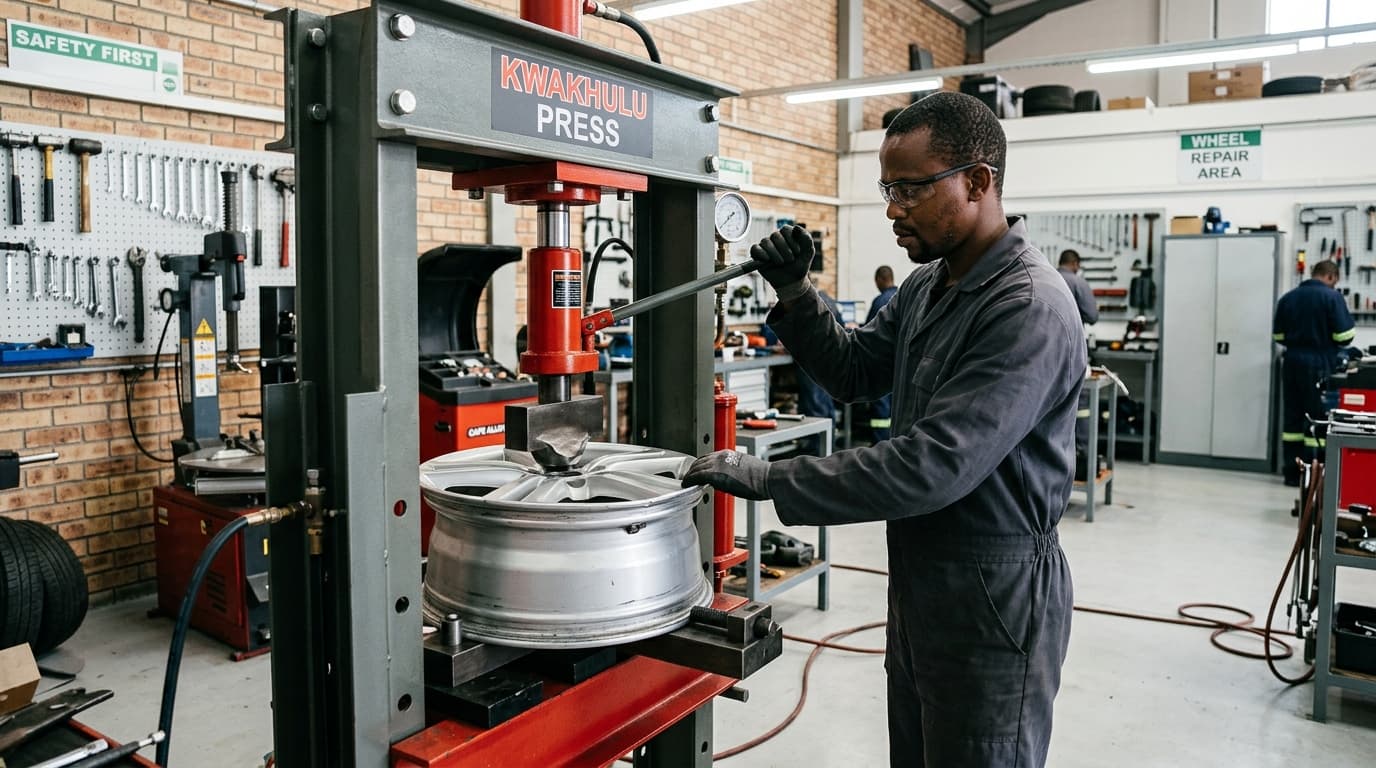
Rim straightening is a precision repair process that restores a bent or buckled alloy wheel to its original roundness and flatness. The most common method used by specialist workshops is hydraulic press straightening, where the wheel is mounted on a specialised machine that applies controlled, gradual hydraulic pressure to push the deformed metal back into spec.
Unlike panel beating, this is not a hit-and-hammer process. The technician works incrementally, checking the rim's runout (lateral and radial deviation) against tolerances with a dial indicator after each press cycle. The goal is to bring the rim within the manufacturer's original runout specification — typically ±0.5 mm for alloy wheels.
At Speedline Mags in Parow, Cape Town, we use industry-grade hydraulic press equipment and follow a methodical process to ensure every straightened wheel is both visually correct and dimensionally safe to drive on.
What Causes Rim Damage?
South African roads are notoriously tough on wheels. The primary culprits are:
- Potholes — a sudden impact at speed causes the tyre to compress fully and the rim to absorb the shock directly
- Kerb strikes — parking or turning too tightly causes lateral deformation on the inner or outer lip
- Speed bumps hit at speed — repeated impact on poorly maintained road humps leads to cumulative bending
- Off-road driving — rocks and uneven terrain cause impact damage on SUV and bakkie rims
The result is typically one of three types of damage: a bent outer lip, a buckled barrel (the inner face of the rim), or a warped bead seat (the surface the tyre seals against). All three can usually be addressed through straightening, provided the damage hasn't exceeded certain thresholds.
How the Hydraulic Press Straightening Process Works
Here's what happens when you bring a damaged wheel to a specialist like Speedline Mags:
Step 1: Visual and Dimensional Assessment
The technician begins with a visual inspection to identify the location and extent of the damage. They then mount the wheel on a balancing machine or runout gauge to measure lateral and radial runout. This baseline reading tells them exactly how far out of spec the rim is and where the worst deformation is located.
Step 2: Heating (Where Required)
Some alloys — especially older or harder alloy compositions — benefit from localised heat application before pressing. A heat gun is used to warm the deformed area just enough to reduce brittleness without compromising the alloy's structural properties. This step isn't always necessary but can improve results on stiffer rims.
Step 3: Hydraulic Press Application
The wheel is positioned on the press fixture, with the damaged section aligned with the press die. Controlled hydraulic pressure is applied in small increments. The technician works methodically, never over-pressing, and checks runout measurements between each cycle. On a moderately damaged wheel this might take 15–20 press cycles to achieve the correct result.
Step 4: Runout Verification
Once the visual shape looks correct, the wheel goes back on the gauge. A properly straightened alloy should show lateral and radial runout within 0.5 mm. Many workshops will aim tighter than this — at Speedline Mags we target under 0.3 mm where the wheel design allows.
Step 5: Post-Repair Inspection
Before the wheel is returned or refurbished, it's checked for cracks using visual inspection and, for high-risk areas, dye penetrant testing. Any crack — regardless of how hairline — disqualifies the wheel from being returned to service. Safety is non-negotiable here.
Rim Straightening Cost in South Africa
Rim straightening pricing in South Africa varies depending on the rim size, severity of the damage, and the workshop. Here's a realistic breakdown for 2026:
| Rim Size | Typical Cost Range | |----------|-------------------| | 15"–17" | R850 – R1,100 | | 18"–19" | R1,100 – R1,400 | | 20"–22" | R1,400 – R1,800 | | 23"+ / Oversized | R1,800+ (quote required) |
These prices are for straightening only. If the rim also has cosmetic damage — scratches, kerb rash, or peeling paint — you'd be looking at additional costs for powder coating or diamond cut refurbishment.
At Speedline Mags, we provide upfront quotes after the assessment, so there are no surprises. In most cases, straightening is significantly cheaper than a replacement wheel — a new OEM alloy for a BMW 3 Series or VW Polo can easily run R3,500–R8,000 per wheel, depending on availability.
Does Insurance Cover Rim Straightening?
In some cases, yes. Comprehensive motor insurance policies in South Africa can cover tyre and rim damage, depending on your insurer and policy terms. Santam, OUTsurance, and Discovery Insure all offer optional tyre and rim cover. If you have this add-on, your straightening costs may be fully covered after the excess. Read our detailed guide on insurance claims for wheel damage for more on how to approach this.
Which Rims Can Be Straightened?
Not every bent rim is a candidate for straightening. Here's how to think about it:
Rims That Are Typically Repairable
- Single-impact bends on the outer lip or barrel
- Moderate buckles with no visible cracking
- Rims where the deformation is localised to one quadrant
- Alloy wheels in good overall structural condition
- Rims that haven't been previously welded or heavily repaired
Rims That Are NOT Safe to Straighten
- Rims with visible cracks, even hairline cracks
- Rims with damage across multiple impact points (indicating more than one major hit)
- Severely bent rims where the structural integrity has clearly been compromised
- Previously welded rims (welding can alter the alloy's heat treatment and create brittle zones)
- Rims with major deformation of the bead seat or spoke junction
If there's any doubt about whether a rim is safe to straighten, the responsible call is to condemn it. At Speedline Mags, we will always tell you honestly when a rim should be replaced rather than repaired — your safety on the road comes first.
Rim Straightening vs. Rim Replacement: How to Decide
The decision between repair and replacement isn't always straightforward. Here's a framework that helps:
Straighten if:
- The damage is clearly single-impact and localised
- No cracks are visible after careful inspection
- The rim is structurally sound in all other respects
- The cost of straightening is substantially less than replacement
Replace if:
- Cracks are present anywhere on the rim
- The rim has already been straightened once before and bent again
- The damage is severe or multi-point
- The rim is a safety-critical component on a high-performance or track vehicle
- Replacement cost is close to repair cost (sometimes the case for smaller, older rims)
For most everyday drivers in Cape Town — whether you're driving a VW Polo in the Northern Suburbs or a Toyota Hilux on the Cape Flats — a single pothole strike that bends a rim without cracking it is a straightforward case for straightening. The repair is quick, effective, and a fraction of replacement cost.
How Long Does Rim Straightening Take?
At Speedline Mags, a standard rim straightening job typically takes 1–3 hours, depending on the severity of the damage and whether any post-repair cosmetic work is being done at the same time. In many cases you can drop off in the morning and collect in the afternoon.
If you need the wheel balanced and fitted to the vehicle, factor in an extra 30–45 minutes. We can coordinate with your tyre fitment centre or handle balancing in-house.
Safety After Rim Straightening: What You Need to Know
A properly straightened rim is safe to drive on. The hydraulic press process doesn't weaken the alloy if done correctly — it simply reverses the deformation. However, there are a few things to keep in mind:
Tyre inspection is essential. If your rim bent in an impact, your tyre almost certainly took a hit too. Internal tyre damage — broken belts, sidewall bruising — isn't always visible from the outside. Have the tyre inspected or replaced if there's any doubt.
Wheel balancing is required. After straightening, the weight distribution of the wheel changes. Always have the wheel rebalanced before driving at highway speeds. An unbalanced wheel causes vibration, tyre wear, and stress on wheel bearings.
Monitor for vibration. In the days after repair, pay attention to how the car feels at highway speed. Any new vibration or pulling should be investigated promptly.
For more on overall wheel safety, see our ultimate wheel care guide.
Why Cape Town Drivers Deal With More Rim Damage
Cape Town's roads — particularly in areas like Parow, Bellville, Mitchells Plain, and along older suburban routes — have some of the most pothole-ridden surfaces in the Western Cape. The combination of ageing infrastructure, heavy rainfall in winter, and high traffic volumes creates conditions that are genuinely punishing on wheels.
For drivers in the Northern Suburbs especially, pothole-related rim damage is almost an inevitability over a few years of regular driving. Knowing that a specialist like Speedline Mags is on hand to assess and straighten damaged rims quickly — and at a transparent price — means you don't have to absorb the full cost of replacement every time.
We also see a high volume of kerb damage repairs from Cape Town's tighter suburban streets and parking scenarios. If you've nicked a kerb, even a seemingly light strike can cause lip damage that affects the tyre bead seal and leads to slow leaks over time.
Book a Rim Straightening Assessment at Speedline Mags
If you're dealing with a bent or buckled rim, the fastest way to know your options is to bring the wheel in for a professional assessment. At Speedline Mags in Parow, Cape Town, we'll inspect the wheel, measure the runout, and give you an honest upfront quote — no obligation.
We service customers from across the Cape Town metro including Bellville, Durbanville, Table View, Blouberg, Somerset West, and beyond. Most straightening jobs can be completed same-day, and we're happy to advise on whether straightening, refurbishment, or replacement makes the most sense for your specific wheel and budget.
Contact Speedline Mags to book your assessment or get a quote. Get your rims straight, get back on the road safely.