
Buckled Wheel: Warning Signs, Safety Risks and Your Repair Options
You're driving along the N1 near Bellville, cruising at a comfortable speed, when you notice a strange vibration through the steering wheel. It wasn't there yesterday. Maybe you clipped a pothole on the way to work this morning, or caught a particularly brutal speedbump in Parow. Whatever the cause, something feels off — and if you're experiencing symptoms like these, there's a real chance you're dealing with a buckled wheel.
A buckled wheel is one of the most common wheel problems we see at Speedline Mags, and it's one of the most misunderstood. Many drivers assume it's a minor inconvenience. In reality, a buckled rim can seriously compromise your vehicle's handling, accelerate tyre wear, and — if left unattended — put you and other road users at risk.
This guide walks you through exactly what a buckled wheel is, how to identify one, why driving on it is dangerous, and what your repair options look like here in Cape Town.
What Is a Buckled Wheel?
A buckled wheel (also called a bent rim or deformed wheel) is a wheel that has been knocked out of its original round shape. Unlike a cracked or broken wheel, a buckle is a bend or warp — usually along the inner or outer lip of the rim, or across the wheel face.
Alloy wheels are particularly vulnerable because they're lighter and stiffer than steel wheels. When they absorb a sudden sharp impact — like a pothole, kerb strike, or poorly placed speedbump — they can deform instead of flex. The result is a wheel that is no longer perfectly circular, and that causes problems with every single rotation.
The severity of a buckle can range from a barely detectable few millimetres of deviation to a visible, obvious deformation you can spot with the naked eye. Both ends of that spectrum matter — even a small buckle can have a significant effect on your vehicle's dynamics.
Warning Signs of a Buckled Wheel
One of the most useful things you can do as a driver is learn to recognise a buckled wheel early. The sooner you catch it, the simpler and less expensive the repair is likely to be. Here are the key symptoms to watch for:
Vibration Through the Steering Wheel or Seat
This is the most reported symptom. If you feel a rhythmic vibration that gets worse at certain speeds — often between 80 and 120 km/h — and the vibration is coming through the steering wheel or the floor of the car, it's worth having your wheels inspected. The vibration occurs because the buckled section of the rim creates an uneven contact point with the road with every revolution.
It's worth noting that this symptom is also associated with wheel imbalance, so it's sometimes dismissed too quickly. If balancing doesn't fix it, a buckled rim is the next thing to check.
Pulling to One Side
A buckled wheel can cause your vehicle to pull left or right, particularly under braking or at speed. This happens because the bent rim alters the tyre's contact patch, affecting the way braking force is distributed. If your car is pulling and your wheel alignment checks out fine, a buckled rim should be on the suspect list.
Unusual Tyre Wear
If you notice uneven wear on one of your tyres — worn more on one edge than the other, or showing scalloping (a wavy, cupped pattern) — a buckled wheel may be the underlying cause. The deformation changes the angle at which the tyre meets the road, causing accelerated and uneven degradation.
A Visible Bump or Flat Spot on the Wheel
Run your hand along the inner and outer edges of your wheels (with the car stationary and the wheel cool). If you feel a raised section, a dip, or a flat area that doesn't match the rest of the rim's profile, that's a physical buckle. On more severe cases, you'll be able to see it just by looking at the wheel from the front or rear of the vehicle.
Slow Tyre Deflation
A buckled wheel can prevent the tyre bead from sealing properly against the rim. If you're topping up a tyre more often than usual without finding a puncture, a deformed rim could be the cause of the air loss.
Why Is Driving on a Buckled Wheel Dangerous?
This is where a lot of drivers underestimate the problem. A small buckle can feel manageable — you notice the vibration, you live with it, you tell yourself you'll sort it out next week. But there are real safety consequences to driving on a bent rim.
Compromised Handling and Braking
A buckled wheel reduces your control of the vehicle. The irregularity in the rim disrupts the smooth, predictable contact between your tyre and the road. In emergency situations — a sudden stop, an evasive manoeuvre — this reduced contact and unpredictable handling can be the difference between avoiding an accident and not.
Risk of Sudden Tyre Failure
A buckle that allows air to leak slowly is gradually weakening the seal between the tyre and the rim. In certain conditions, this can lead to a blowout — a sudden, rapid loss of pressure. At highway speeds, a blowout is extremely dangerous. South African roads, particularly around Cape Town's southern suburbs and along the N2, already present challenges without adding a compromised wheel into the mix.
Accelerated Damage to Suspension Components
Your suspension — wheel bearings, control arms, struts — is designed to absorb road impacts in a controlled way. A buckled wheel introduces a repetitive, off-axis force with every rotation. Over time, this accelerates wear on wheel bearings and suspension joints, turning a relatively inexpensive wheel repair into a significantly more expensive suspension job.
Tyre Damage
Running on a buckled rim puts constant abnormal stress on the sidewall and bead of the tyre. This can lead to internal damage that isn't visible from the outside, meaning a tyre that looks fine may have compromised structural integrity.
What Causes a Buckled Wheel?
Understanding how buckles happen helps you prevent them in future. The most common causes we see at Speedline Mags include:
Pothole impacts — Cape Town's road network is under pressure, and potholes are a fact of life for drivers in Parow, Bellville, Mitchells Plain, and beyond. A sharp-edged pothole hit at speed transmits a sudden, concentrated force to the rim that it simply wasn't designed to absorb.
Kerb strikes — Parking in a hurry, misjudging a tight turn, or clipping a high pavement can bend the outer lip of the rim. This type of buckle often comes with visible kerb rash too.
Speedbumps taken too fast — A poorly-made or poorly-marked speedbump hit at speed can cause just as much damage as a pothole. Low-profile tyres offer almost no cushioning, so the rim takes the full force.
Overloading — Consistently carrying loads heavier than your vehicle's rated capacity puts excess stress on all four wheels. Over time, this can cause gradual deformation even without a single dramatic impact.
Worn tyres — Thin tread offers less buffering between the road and the rim. Running tyres down to their wear indicators (or beyond) makes buckle damage far more likely.
Buckled Wheel Repair Options in Cape Town
If you've identified the symptoms and confirmed you have a buckled wheel, you have a few options. Here's what the repair landscape looks like:
Wheel Straightening (Hydraulic Press Method)
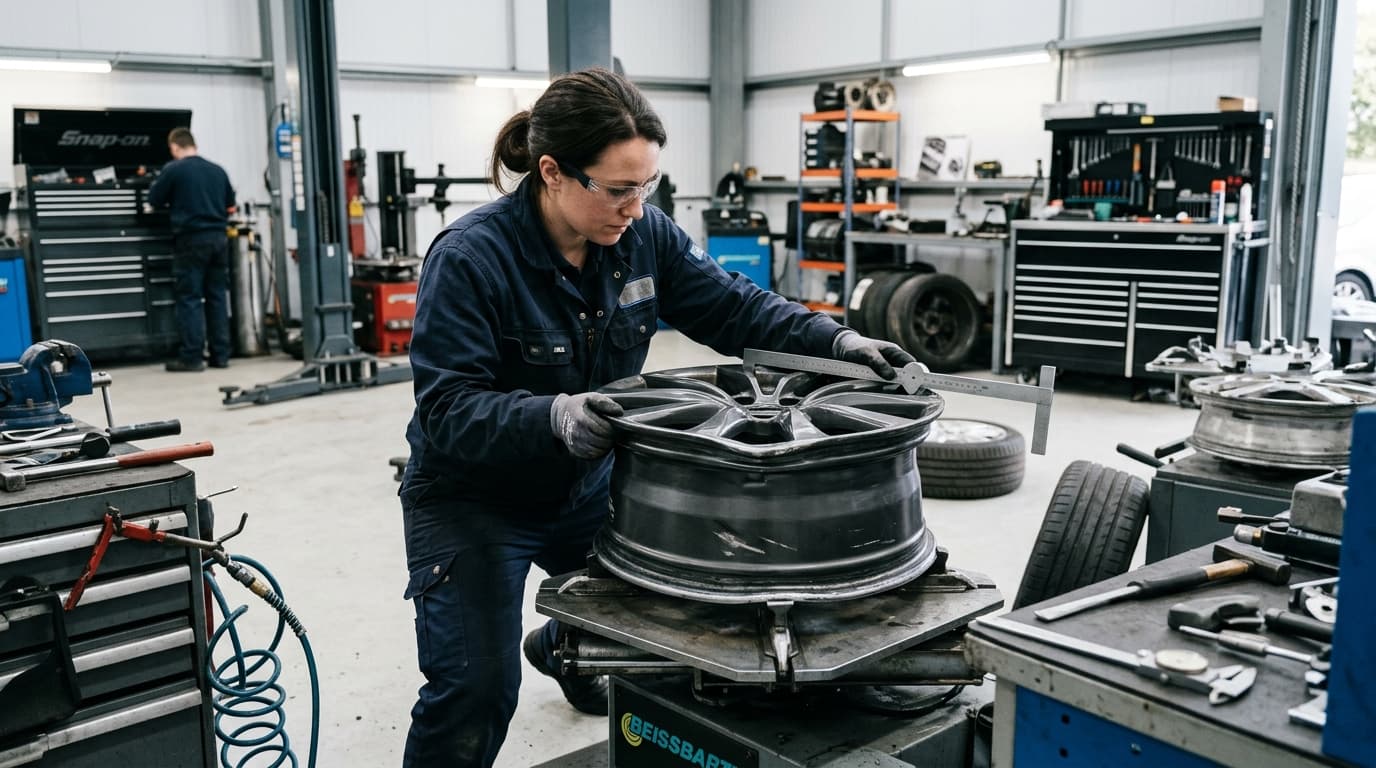
For most buckled alloy wheels, hydraulic straightening is the go-to repair method. The wheel is removed from the vehicle, demounted from the tyre, and placed on a specialist press machine. The technician uses controlled hydraulic pressure to gradually and carefully reshape the rim back to its original profile.
At Speedline Mags in Parow, this process is carried out by experienced technicians who've worked on everything from VW Polo rims to BMW 5 Series alloys and Toyota Hilux steel wheels. After straightening, the wheel is run on a balancer to confirm it's within tolerance before being returned to your vehicle.
This repair works well for buckles where the metal hasn't cracked or thinned excessively. A good technician will always inspect the wheel thoroughly before committing to a repair — if the deformation has caused micro-cracks or if the wheel has been significantly weakened, replacement may be the safer option.
Combined Straightening and Refurbishment
In many cases, the impact that caused the buckle has also caused cosmetic damage — kerb rash, paint chips, or scuffing. This is a good opportunity to have the wheel straightened and refurbished at the same time, so it comes back looking as good as it functions. Options include powder coating in your choice of colour, or a diamond cut finish that restores the factory look.
For more on refurbishment options, read our guides on diamond cut vs powder coating and the complete powder coating guide.
When to Replace Rather Than Repair
Not every buckled wheel can or should be repaired. A wheel should be replaced if:
- The buckle has caused a crack in the rim (structurally unsafe to repair)
- The metal has thinned excessively at the point of deformation
- The wheel has been buckled and re-straightened multiple times
- The deformation is too severe to restore within safe tolerances
Our technicians will always give you an honest assessment. If a wheel isn't safe to repair, we'll tell you so — even if that's not what you were hoping to hear. Safety isn't negotiable.
Buckled Wheel Repair Cost Guide
Costs vary based on the severity of the buckle, the wheel size, and the material (alloy vs steel). As a general guide for Cape Town customers in 2026:
- Minor buckle straightening (alloy): From around R400–R700 per wheel
- Moderate buckle with significant deformation: R700–R1,200 per wheel
- Straightening + powder coat refurbishment: R900–R1,800 per wheel depending on finish
- Diamond cut refurbishment with straightening: R1,200–R2,200 per wheel
These are guide prices only — the only way to get an accurate quote is to bring the wheel in for inspection. We offer free assessments, so there's no cost to finding out exactly where you stand.
For a broader overview of wheel repair pricing, see our wheel repair cost guide for South Africa.
How to Prevent Buckled Wheels
You can't always avoid road hazards, but these habits significantly reduce your risk:
Maintain proper tyre pressure. Correctly inflated tyres provide a much better buffer between the rim and the road. Under-inflated tyres offer almost no protection at all — the rim is essentially riding much closer to the surface.
Choose appropriate tyre profiles. If you've fitted low-profile tyres (45-series or lower) on your vehicle for the look, be aware that you have very little sidewall to absorb impacts. Drive more cautiously over rough road surfaces.
Slow down for potholes and speedbumps. It sounds obvious, but it's worth repeating. The energy transferred to your rim on pothole impact scales dramatically with speed.
Don't overload your vehicle. Check your owner's manual for the rated payload and stick to it.
Inspect your wheels regularly. A quick visual check and a feel around the rim edges every few weeks takes two minutes and can catch a developing buckle before it becomes serious.
For a full maintenance routine, read our ultimate wheel care guide.
Why Choose Speedline Mags for Buckled Wheel Repair?
Speedline Mags is based in Parow, making us accessible to drivers across the Cape Town Northern Suburbs — including Bellville, Durbanville, Goodwood, and beyond. We specialise in alloy wheel repair and refurbishment, and we carry out wheel straightening on-site using professional-grade equipment.
What sets us apart:
- Free wheel assessments — we'll tell you honestly what the wheel needs
- Fast turnaround — most straightening jobs are completed the same day
- Full refurbishment options — repair and refresh in one visit
- Transparent pricing — no hidden fees, no surprises
- Experienced technicians — we work on all makes and models, from economy hatchbacks to performance vehicles and 4x4s
We understand that wheel damage is often unexpected and frustrating. Our goal is to get you back on the road safely, without any unnecessary upselling.
Get Your Buckled Wheel Assessed Today
If you've noticed any of the warning signs described above — vibration, pulling, slow air loss, or visible deformation — don't put it off. A buckled wheel only gets worse with continued driving, and the longer you wait, the higher the risk to both your safety and your wallet.
Contact Speedline Mags in Parow, Cape Town to book a free assessment. We'll inspect your wheel, give you a clear diagnosis, and walk you through your repair options. Whether it's a straightforward straightening or a full refurbishment, we'll get it sorted.
Reach us via our website's contact form or give us a call. We're here Monday to Friday during business hours and welcome walk-ins for assessments.
Looking for more information? Browse our related guides: