
Wheel X-Ray & Crack Detection: How Pros Find Hidden Damage
Your alloy wheels look fine. The surface is smooth, the finish is intact, and there's no visible damage after that pothole you hit three weeks ago on the N1. But what if there's a hairline crack running through the metal — invisible to the eye, invisible to a quick tap of the knuckle, but growing with every kilometre you drive?
Wheel crack detection x-ray and non-destructive testing (NDT) techniques exist precisely for this reason. In professional wheel refurbishment and repair, visual inspection is never the whole story. The difference between a wheel that's safe to repair and one that should be retired permanently often comes down to tests that most car owners have never heard of — and that most roadside tyre shops don't perform.
This guide explains the science and practice behind how professionals detect hidden cracks in alloy wheels, why it matters for your safety, and what Speedline Mags uses to certify repairs at our Parow workshop.
Why Visual Inspection Isn't Enough
The human eye is remarkably good at detecting surface damage — a bent rim, a crack that's opened up, obvious corrosion pitting. But alloy wheels fail in ways that are far more subtle.
Aluminium alloys — the material used in virtually all mag wheels on modern vehicles — are subject to fatigue cracking. When a wheel flexes repeatedly under load (which every wheel does, thousands of times per kilometre), small stress concentrations in the metal can develop into microscopic cracks. These cracks typically start at the inner surface of the wheel, at weld points from previous repairs, or at areas of thin section near the spoke-to-barrel junction.
A 2mm hairline crack produces no vibration, causes no immediate handling issue, and sits completely below the threshold of what even an experienced technician can see under workshop lighting. But it is propagating. Under the heat and stress of highway driving, that crack can open rapidly — sometimes catastrophically.
In South Africa, where road surfaces can be brutally unforgiving — particularly in Bellville, Parow and along the R300 — alloy wheels take more impact loading than they were designed for in European driving cycles. This makes hidden crack detection not a luxury, but a genuine safety necessity for any responsible wheel refurbishment.
The Main Non-Destructive Testing Methods for Alloy Wheels
The umbrella term for testing techniques that detect flaws without cutting, drilling, or otherwise destroying the part is non-destructive testing, or NDT. Several NDT methods are applicable to alloy wheel inspection.
Dye Penetrant Inspection (DPI)
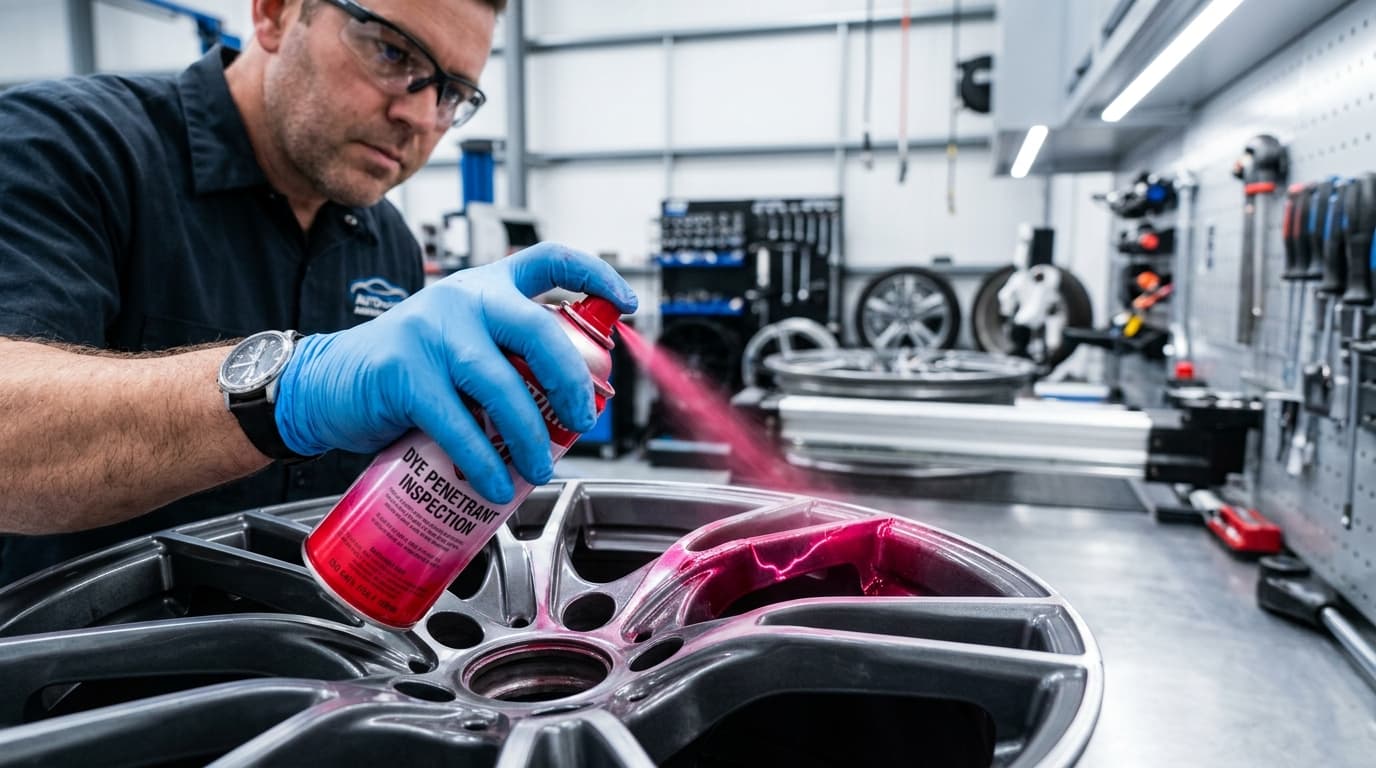
Dye penetrant inspection — sometimes called liquid penetrant testing (LPT) — is the most widely used method in wheel refurbishment workshops globally, including at Speedline Mags. The process works as follows:
- Surface preparation. The wheel is cleaned thoroughly to remove all contamination, grease, and paint. Any coating on the inspection area must be stripped.
- Penetrant application. A brightly coloured (typically red) or fluorescent liquid penetrant is applied to the wheel surface and allowed to dwell for a set period — usually 10 to 30 minutes. The penetrant has very low surface tension, allowing it to seep by capillary action into any surface-breaking crack, however fine.
- Excess removal. The surface penetrant is carefully wiped or washed away, leaving only the material that has been drawn into cracks.
- Developer application. A white developer is applied. This draws the penetrant back out of any cracks by reverse capillary action, creating a visible indication — a vivid red or fluorescent line against the white background.
- Inspection. Under visible light (for red dye) or UV/black light (for fluorescent penetrant), the technician examines the wheel surface for indications.
DPI is highly effective for surface-breaking cracks — cracks that originate at or break through the wheel surface. It won't detect cracks buried deep within the metal. It's particularly useful for examining weld zones on previously repaired wheels, spoke roots, and the bead seat area.
The limitation: it cannot see cracks that don't reach the surface. A crack that began as an internal void and hasn't yet propagated to the surface will be missed by DPI.
Radiographic Inspection (X-Ray Testing)
When the industry refers to wheel crack detection x-ray, this is the method. Industrial radiography uses either X-ray beams or gamma radiation to penetrate the metal. The wheel is placed between the radiation source and a detector (film or digital panel), and variations in material density — including cracks, voids, porosity, and inclusions — are rendered visible in the resulting image.
Radiographic inspection is the most comprehensive method for detecting internal defects. It can reveal:
- Internal cracks that haven't yet reached the surface
- Porosity (small gas voids from the casting process that weaken the structure)
- Inclusions (foreign material trapped during casting)
- Prior repair defects such as incomplete fusion in weld repairs
The disadvantage is cost and access. Industrial X-ray equipment is expensive, requires a licensed operator and a controlled radiation area, and is typically found in aerospace, heavy engineering, and specialised automotive safety testing rather than in standard wheel repair workshops. For most reputable wheel repairers, radiographic inspection is used as a verification step for wheels with suspect history — track use, severe impact, or previously welded repairs — rather than for every wheel processed.
Ultrasonic Testing (UT)
Ultrasonic testing introduces high-frequency sound waves into the wheel material through a transducer coupled to the surface. When the sound wave encounters an interface — the back wall of the metal, or a crack — it reflects. The time and amplitude of the returned signal indicates the location and size of any discontinuity.
UT is effective for detecting both surface and subsurface flaws, and it doesn't require radiation equipment. However, it requires highly trained operators to interpret the signals accurately, and the complex geometry of alloy wheels — curved spokes, variable wall thickness, multiple alloy compositions — makes signal interpretation challenging. It is more commonly applied to cast wheel quality control in manufacturing than to workshop repair inspection.
Magnetic Particle Inspection (MPI)
MPI works by magnetising the test piece and applying fine magnetic particles (as a powder or suspended in liquid) to the surface. Magnetic flux leakage at cracks causes the particles to cluster visibly at the defect. The technique is fast, sensitive, and excellent for ferromagnetic materials — but aluminium alloy wheels are non-magnetic, so MPI is not applicable. It is used for steel wheel inspection, not alloy mags.
What Happens When a Hidden Crack Is Found
The discovery of a crack during NDT inspection triggers a decision tree. Not all cracks are equal — their location, orientation, depth, and the wheel's intended use all factor into the outcome.
Superficial cracks in low-stress areas — such as minor surface cracking on the cosmetic barrel face — may be treatable by careful machining to remove the defect, followed by re-inspection to confirm complete removal, and then refinishing.
Cracks at spoke roots, weld zones, or the bead seat are treated with far more caution. The bead seat is the portion of the wheel that retains the tyre under pressure — a crack here is a potential tyre separation event. Cracks at spoke roots involve the structural load path. In these cases, the standard industry guidance is retire the wheel.
Previously welded wheels showing new cracking are almost always retired. Welding concentrates heat and introduces residual stress into the heat-affected zone, which can become a preferred crack initiation site. A wheel that has cracked at or near a previous weld repair is telling you the structural capacity of that area is exhausted.
At Speedline Mags, when a wheel is condemned on structural grounds, we communicate this clearly to the customer and document our findings. No reputable wheel repairer will weld and return a wheel that has failed structural inspection — the liability exposure and, more importantly, the safety risk to the customer, are too significant.
Red Flags That Should Trigger NDT Inspection
For the average Cape Town driver, knowing when to request professional crack detection — rather than just a visual inspection — can be the difference between a safe repair and a dangerous one.
Consider requesting NDT inspection when:
- Your wheel has taken a serious impact. Not every pothole strike — but a hard kerb strike, a severe pothole at speed, or anything that visibly bent the rim qualifies.
- You've had a wheel repaired previously. Welded repairs, in particular, should be re-inspected before refinishing and return to service.
- You drive a heavy vehicle or regularly carry maximum load. Toyota Hilux owners running at GVM, or vehicles towing trailers, put dramatically more stress on wheels than passenger car usage.
- You use your vehicle for track days or spirited driving. High-speed cornering loads are multiples of straight-line driving loads.
- You've experienced unexplained vibration since an impact. Vibration that can't be resolved by balancing sometimes indicates a wheel that's structurally compromised.
- You're buying second-hand wheels. Used wheels with unknown history are candidates for at least dye penetrant inspection before use.
How Speedline Mags Approaches Wheel Safety Certification
At our workshop in Parow, we serve customers from across the Northern Suburbs — Bellville, Durbanville, Brackenfell, Kraaifontein, and beyond — as well as clients who travel from the Southern Suburbs and Winelands for specialist work.
Our wheel inspection process before any refurbishment begins with a structured assessment: we examine the wheel under controlled lighting for obvious structural damage, check the run-out (flatness) on the lathe before cutting, and for any wheel with a suspect history, we apply dye penetrant testing to the high-stress zones — spoke roots, weld areas, and bead seats — before committing to repair.
For wheels that have been previously welded — either by us in a prior repair or by another shop — we apply penetrant inspection after weld preparation and again after the weld is completed and dressed, before any refinishing begins. This two-stage inspection catches defects introduced during welding itself.
We do not take shortcuts on structural inspection. A wheel that fails inspection is rejected from the refurbishment process, full stop. We'd rather lose the repair revenue than return a structurally compromised wheel to the road.
This approach aligns with what responsible operators across the industry follow — the principle that cosmetic repair should never be applied to a structurally suspect wheel. A beautifully diamond-cut finish on a cracked spoke is a dangerous outcome, not a successful one.
The Cost Argument for Proper Inspection
South African drivers are understandably cost-conscious, and alloy wheel repair costs are already a significant consideration. It can feel like NDT inspection adds unnecessary expense to a straightforward repair.
But consider the alternative costs:
- A wheel that fails structurally at speed can cause a tyre blowout, with potential for loss of control. The insurance, repair, and human costs of even a low-speed incident triggered by wheel failure dwarf the cost of proper inspection.
- Under South African law and common-law product liability principles, a workshop that returns a structurally unsound wheel to a customer without adequate inspection has significant exposure. Customers who are aware of this fact should choose repairers who take inspection seriously.
- Wheel replacement costs — buying a new or quality second-hand OEM wheel — typically range from R2,000 to R8,000 or more depending on make and size. The cost of dye penetrant inspection as part of a repair process is a fraction of this.
Proper inspection isn't a premium add-on. It's the baseline of responsible wheel repair.
Internal Links for Further Reading
If you're dealing with wheel damage, the following guides may help:
- Cracked Alloy Wheel: Repair or Replace?
- Alloy Wheel Welding: When Is It Safe?
- How Potholes Damage Your Wheels and What to Do
- Signs Your Wheels Need Professional Repair
- Wheel Repair Cost Guide for South Africa
Conclusion: Don't Skip the Inspection
Hidden cracks in alloy wheels are a genuine safety risk — and they are genuinely hidden from visual inspection alone. Wheel crack detection x-ray, dye penetrant inspection, and ultrasonic testing exist because professionals know that what you can't see can hurt you.
When you bring a wheel to Speedline Mags for repair, you're not just paying for a new finish. You're paying for a process that includes structural assessment — because returning a safe, certified wheel is the only outcome we consider acceptable.
If you've taken a significant impact recently, had a wheel repaired elsewhere, or are buying used alloys, don't rely on visual inspection alone. Contact Speedline Mags in Parow, Cape Town for a professional assessment — we'll tell you honestly whether your wheel is safe to repair or needs to be replaced.
Call or WhatsApp us to book your wheel inspection, or visit our workshop in Parow to discuss your specific situation. Our team works with vehicles from across Cape Town's Northern Suburbs and beyond, and we're happy to advise before you commit to any repair.