
Toyota Hilux Tyre Pressure Guide: All Trims & PSI Settings
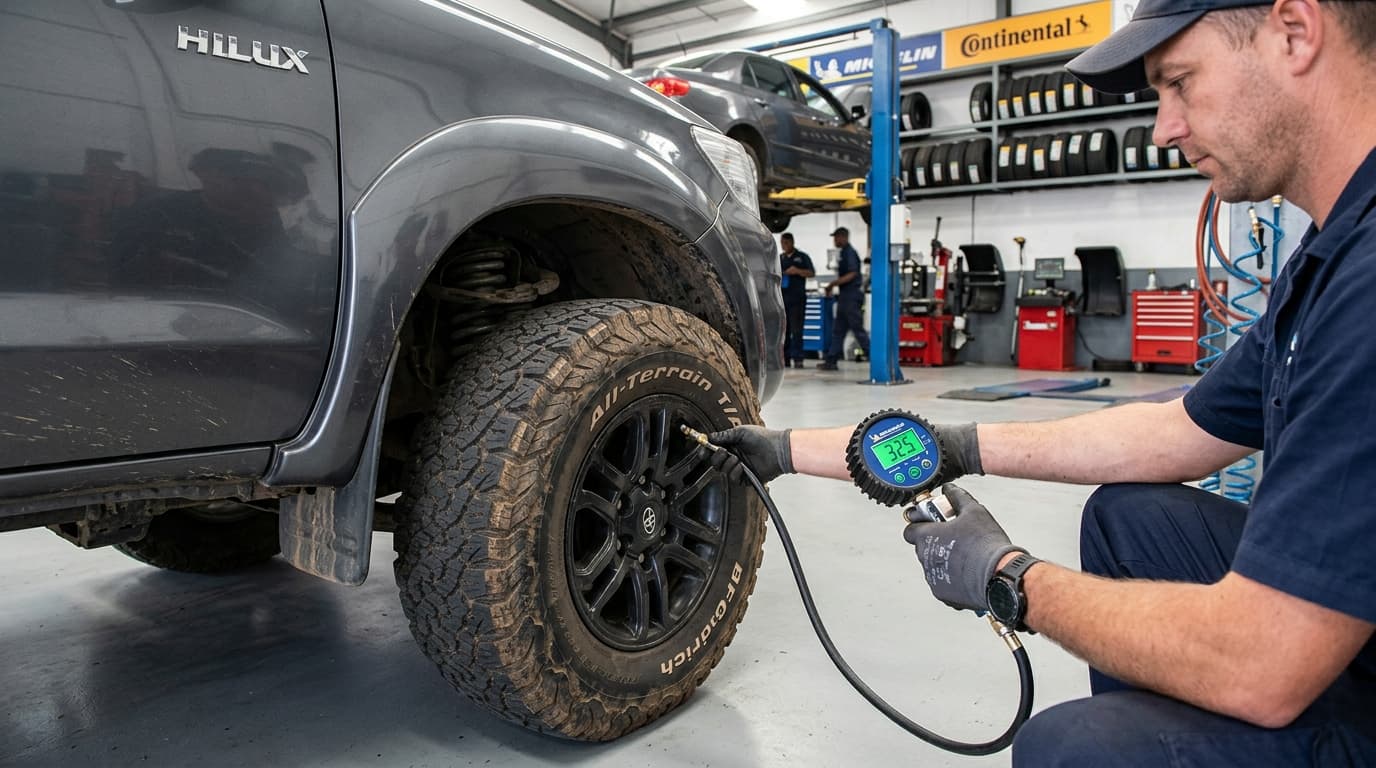
The Toyota Hilux is South Africa's best-selling vehicle — and for good reason. It's tough, reliable, and handles everything from Bellville school runs to Karoo farm tracks without complaint. But even the toughest bakkie needs correctly inflated tyres to perform safely, handle well, and protect those wheels from damage.
Running the wrong hilux tyre pressure is one of the most common causes of premature tyre wear, buckled rims, and blowouts — especially on SA roads where potholes are a daily hazard. This guide covers correct PSI settings for every major Hilux variant sold in South Africa, so you can set it and forget it.
Why Tyre Pressure Matters More Than You Think
Most Hilux owners check tyre pressure occasionally — usually when a tyre looks visibly low. That's too late. A tyre can lose up to 30% of its pressure and still look fine to the naked eye.
The consequences of incorrect pressure compound over time:
Under-inflation causes the tyre sidewall to flex excessively on every rotation. This generates heat, accelerates shoulder wear, and puts enormous stress on the rim. Hit a pothole with underinflated tyres and you're far more likely to buckle or crack the rim than if the tyre was properly inflated — because there's simply less air cushion to absorb the impact.
Over-inflation makes the tyre ride on its centre tread only, causing rapid centre wear and a harsher ride. Over-inflated tyres also have reduced contact with the road, meaning longer braking distances and reduced grip in wet conditions.
For a Hilux carrying a heavy load in the back, tyre pressure becomes even more critical. The correct loaded vs unloaded PSI settings can differ by up to 10 PSI — and running load pressures when empty causes just as many problems as the reverse.
Toyota Hilux Tyre Pressure Settings by Variant
The Hilux has been sold in South Africa in dozens of configurations over the years. Below are the recommended tyre pressure settings for current-generation (2016–present) models and common earlier variants. Always cross-reference with the placard inside your driver's door jamb — the sticker there is specific to your vehicle and takes precedence over general guidelines.
Hilux 2.4 GD-6 (Single Cab, 4x2)
The single cab 2.4 is a workhorse — often used by tradespeople and farmers carrying tools and materials. Tyre size is typically 215/70 R15 or 265/65 R17 depending on trim level.
| Condition | Front | Rear | |-----------|-------|------| | Unloaded | 28 PSI (1.9 bar) | 28 PSI (1.9 bar) | | Loaded (GVM) | 32 PSI (2.2 bar) | 38–42 PSI (2.6–2.9 bar) |
Single cabs are often loaded hard in the rear. When carrying a full load, increase rear pressure significantly — this prevents the rear end from wallowing and protects the rim from pinch flats on rough surfaces.
Hilux 2.4 GD-6 (Double Cab, 4x2)
The double cab 2.4 is the most common family Hilux in Cape Town's Northern Suburbs. Standard tyre size is usually 265/65 R17 or 265/60 R18.
| Condition | Front | Rear | |-----------|-------|------| | Unloaded | 30 PSI (2.1 bar) | 30 PSI (2.1 bar) | | Loaded (GVM) | 33 PSI (2.3 bar) | 36 PSI (2.5 bar) |
Hilux 2.8 GD-6 (Double Cab, 4x4 — Legend, Rogue, GR Sport)
The 2.8 diesel in 4x4 guise is a heavier vehicle and typically runs on larger tyres — 265/65 R17 is common, with the GR Sport on 265/60 R18.
| Condition | Front | Rear | |-----------|-------|------| | Unloaded (on-road) | 32 PSI (2.2 bar) | 32 PSI (2.2 bar) | | Loaded (on-road) | 35 PSI (2.4 bar) | 38 PSI (2.6 bar) | | Off-road / soft terrain | 20–22 PSI (1.4–1.5 bar) | 20–22 PSI (1.4–1.5 bar) |
Important for 4x4 owners: When airing down for off-road driving, always re-inflate to road pressures before returning to tar. Driving at highway speeds on under-inflated tyres causes rapid tyre failure and can cause you to lose control of the vehicle.
Hilux 2.8 GD-6 (Single Cab, 4x4 — Raider, Workmate)
| Condition | Front | Rear | |-----------|-------|------| | Unloaded | 30 PSI (2.1 bar) | 32 PSI (2.2 bar) | | Loaded | 33 PSI (2.3 bar) | 40–44 PSI (2.8–3.0 bar) |
Working single cabs in 4x4 configuration carry enormous loads. A bakkie loaded with bricks, sand, or agricultural supplies can easily approach GVM. In these cases, rear pressure needs to be considerably higher to support the load and protect the rim.
How to Check Your Hilux Tyre Pressure Correctly
Checking tyre pressure sounds simple, but there are a few things that trip people up:
Check Cold — Always
Tyre pressure readings are only accurate when the tyres are cold. After driving even 2–3 km, the air inside the tyre heats up and pressure increases. If you check after driving, you'll get a falsely high reading and may let air out of a correctly inflated tyre.
Best practice: check pressure in the morning before you drive, or after the vehicle has been standing for at least three hours.
Use a Quality Gauge
The gauges at petrol stations are notoriously inaccurate — often reading 3–5 PSI out. Invest in a quality digital tyre pressure gauge (Ryobi, Michelin, and Steelman are available from Makro and Builders Warehouse in Cape Town for under R300). It's one of the best R300 you'll spend on your Hilux.
Don't Forget the Spare
The spare wheel is often neglected until you need it urgently — which is exactly the wrong time to discover it's flat. Check your spare every time you check your road tyres. For a standard Hilux spare, keep it at the same pressure as your road tyres.
Seasonal and Load Adjustments for South African Conditions
Winter Driving in Cape Town
Cape Town's wet winters bring cold mornings and slippery roads. Cold air is denser, which means tyre pressure naturally drops slightly when temperatures fall. For every 10°C drop in temperature, tyre pressure decreases by approximately 1 PSI (0.07 bar).
In practice, this means if you set your tyres at 32 PSI on a warm summer day (30°C), they might read 29–30 PSI on a cold winter morning (10°C). This is a noticeable difference and worth checking regularly through the Cape winter months.
Travelling Through the Karoo or Northern Cape
The Karoo's extreme summer heat (40°C+) has the opposite effect — tyre pressure increases as the air heats up. Don't bleed air from a hot tyre on a Karoo road trip; the pressure increase from driving is normal and expected. Wait until the tyres have cooled down before making any adjustments.
Towing a Trailer
When towing, increase all four tyre pressures by 2–3 PSI above normal road settings. The additional drawbar weight shifts load onto the rear axle, and the increased tyre stiffness helps maintain stability and prevent trailer sway.
Consult your Hilux owner's manual for the maximum towing capacity and specific tyre recommendations for your trim level.
When Wrong Tyre Pressure Causes Wheel Damage
At Speedline Mags in Parow, we see the direct results of chronic under-inflation regularly. The most common scenario: a Hilux owner runs slightly low on pressure for months without noticing. Then they hit one of Cape Town's notorious potholes on the N1 or De Waal Drive, and the rim buckles or cracks.
The physics are straightforward — an under-inflated tyre acts as a weaker buffer between the rim and the road. When the tyre hits a sharp pothole edge, the tyre compresses completely and the rim takes the full impact. A correctly inflated tyre absorbs far more of that impact before the rim is involved.
We've repaired hundreds of buckled and cracked Hilux rims over the years. Many could have been avoided with correct tyre pressure maintenance.
If you're in the Northern Suburbs — Bellville, Parow, Durbanville, Kraaifontein — and you've hit a pothole and suspect rim damage, look for these signs:
- Vibration at highway speed (especially 80–120 km/h) that wasn't there before
- Steering pulling to one side after hitting a pothole
- Tyre losing pressure slowly without an obvious puncture (could indicate a rim seal issue)
- Visible dent or deformation on the rim face or inner barrel
A buckled Hilux rim is repairable in most cases. Our wheel straightening service uses a hydraulic press to restore the rim to factory spec, and we can check for hairline cracks that are invisible to the naked eye.
Tyre Pressure for Aftermarket Wheels on the Hilux
Many Hilux owners upgrade to aftermarket alloy wheels for improved looks and reduced unsprung weight. Common fitments include:
- 17-inch alloys with 265/65 R17 — same as factory
- 18-inch alloys with 265/60 R18 or 275/55 R18
- 20-inch alloys with 275/55 R20 (lowered profile)
When you change tyre size, the recommended pressure can change slightly. A lower-profile tyre (shorter sidewall) has less flexing capacity and may need slightly higher pressure to maintain the correct load-carrying ability. Always confirm pressure settings with your tyre fitment centre when upgrading wheels and tyres.
For aftermarket alloys, tyre pressure matters even more for preserving the finish. Under-inflated tyres cause the wheel to flex more on the mounting face, which over time can loosen wheel nuts and cause micro-movement that damages the hub bore area.
TPMS on the Hilux: What You Need to Know
Newer Hilux models (SR5+, Legend, GR Sport, Rogue from 2021 onwards) are fitted with a Tyre Pressure Monitoring System (TPMS). The dashboard warning light illuminates when any tyre drops more than 25% below the recommended pressure.
A few things to know about Hilux TPMS:
-
It's a warning system, not a pressure guide. By the time the light comes on, the tyre is already significantly low. Proactive manual checks remain important.
-
After adjusting pressure, the TPMS light may take 10–15 minutes of driving to reset. If it doesn't clear after driving, the system may need to be reset manually via the vehicle's settings menu.
-
Aftermarket wheel upgrades can affect TPMS sensors. If you've fitted new wheels and the TPMS light is on, the sensors in the new wheels may not be programmed to your vehicle. A Toyota dealership or a specialist can relearn the sensors.
-
Older Hilux models (pre-2021) don't have TPMS, making manual pressure checks even more important.
How Often Should You Check Hilux Tyre Pressure?
The minimum is once a month and before any long journey. For a Hilux used for commercial purposes or regularly carrying heavy loads, weekly checks are advisable.
Build it into a routine — check every Sunday morning before the week starts, or every time you fill up with fuel. Modern digital gauges take less than two minutes to check all four tyres and the spare.
Get Your Hilux Wheels Checked in Cape Town
If you've noticed vibration, pulling, or suspect pothole damage to your Hilux rims, bring it in to Speedline Mags in Parow. We specialise in alloy wheel repair and refurbishment for bakkies and SUVs across the Northern Suburbs — Bellville, Durbanville, Kraaifontein, Table View, and beyond.
We can straighten buckled rims, repair cracks, and refinish wheels in powder coat, diamond cut, or custom colours. Check out our Toyota wheel repair guide for more information on what we can do for your Hilux.
Contact Speedline Mags:
- Location: Parow, Cape Town, Western Cape
- Phone: Contact us via the website
- Services: Wheel straightening, crack repair, powder coating, diamond cut, full refurbishment
Don't wait until a flat or blowout forces the issue — correct tyre pressure is the cheapest maintenance you can do for your Hilux.