
Toyota Fortuner Tyre Pressure Guide: All Models & PSI Settings
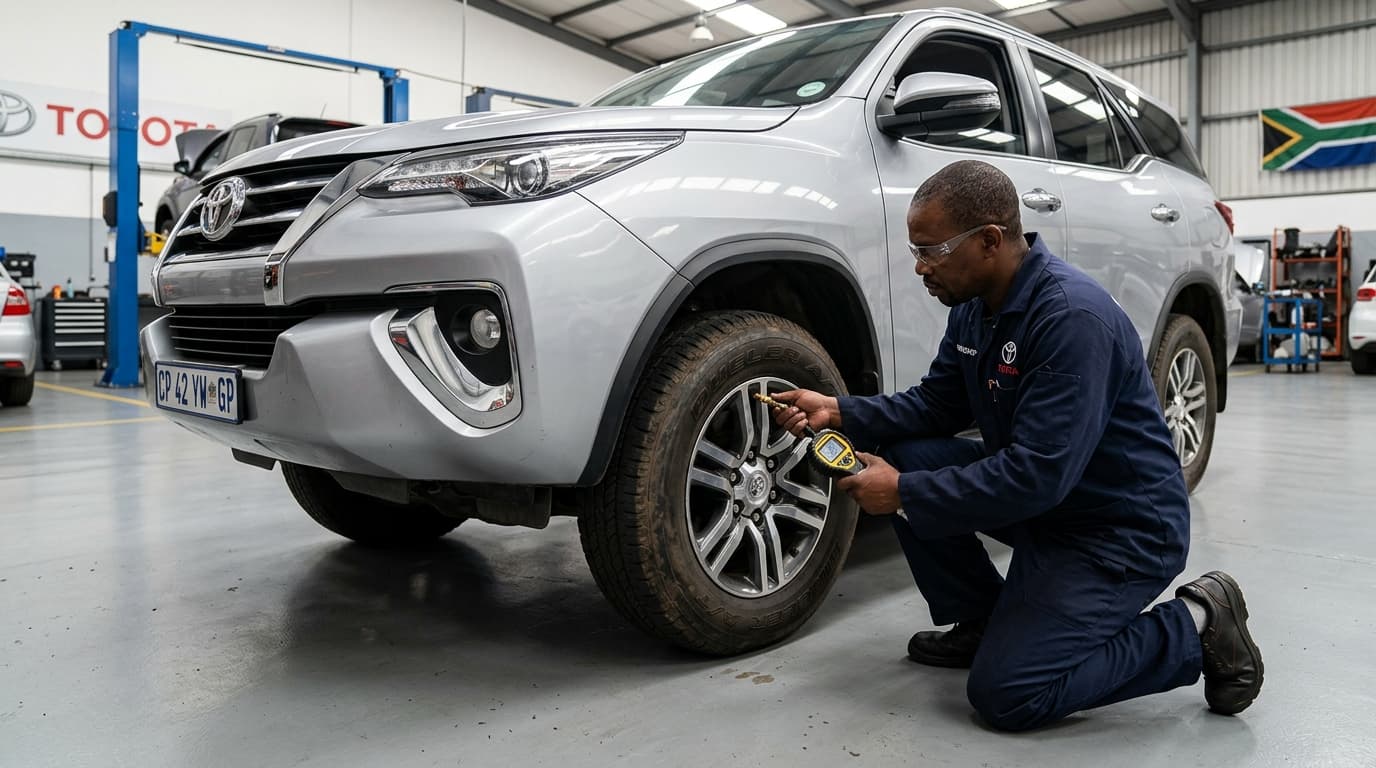
If you drive a Toyota Fortuner, getting your tyre pressure right is one of the simplest — and most overlooked — things you can do to protect your wheels, extend your tyre life, and keep your family safe. Whether you're running the 2.4 diesel, the 2.8 GD-6, a 4x2 or a 4x4, the correct PSI settings differ, and using the wrong pressure can cause premature wear, uneven tyre contact, poor fuel economy, and even rim damage.
This guide covers the fortuner tyre pressure recommendations for all current models sold in South Africa, including the correct settings for highway cruising, loaded driving, and off-road use. We'll also explain how to find the manufacturer's spec on your own vehicle and what happens to your rims when pressure is consistently wrong.
Why Tyre Pressure Matters More Than You Think
Most drivers know they should check tyre pressure, but few understand the knock-on effects when it's wrong — particularly on a heavy SUV like the Fortuner.
Under-inflation causes the tyre sidewalls to flex excessively. This generates heat, accelerates sidewall wear, and increases rolling resistance. In severe cases, a chronically under-inflated tyre can fail on the highway. It also puts abnormal stress on your alloy wheels — the sidewall squirms under load and can eventually cause bead damage or cracking on the inner rim lip, which we see regularly at Speedline Mags.
Over-inflation reduces the tyre's contact patch with the road, meaning the centre of the tread wears faster than the edges. It also makes your ride harsher and reduces your ability to brake in wet conditions. On bumpy Cape Town roads and pothole-heavy sections across the Western Cape, over-inflated tyres transfer more shock directly into the wheel — increasing the chance of cracking or buckling on impact.
Getting the pressure right isn't just about comfort — it directly protects your investment in your wheels.
Toyota Fortuner Tyre Pressure: Standard PSI Settings (South Africa)
The standard tyre sizes fitted to current-generation Fortuners sold in South Africa are 265/65 R17 (on the GX and GD-6 4x2) and 265/60 R18 (on the VX and Legender 4x4). Always verify your actual tyre size on the sidewall before applying pressure settings.
Fortuner 2.4 GD-4 (4x2) — 265/65 R17
| Condition | Front (PSI) | Rear (PSI) | |---|---|---| | Standard/Highway | 36 PSI | 36 PSI | | Loaded (full passengers + luggage) | 36 PSI | 40 PSI | | Off-road (soft terrain) | 26–28 PSI | 26–28 PSI |
Fortuner 2.8 GD-6 (4x2) — 265/65 R17
| Condition | Front (PSI) | Rear (PSI) | |---|---|---| | Standard/Highway | 36 PSI | 36 PSI | | Loaded (full passengers + luggage) | 36 PSI | 40 PSI | | Off-road (soft terrain) | 26–28 PSI | 26–28 PSI |
Fortuner 2.8 GD-6 (4x4) — 265/60 R18
| Condition | Front (PSI) | Rear (PSI) | |---|---|---| | Standard/Highway | 35 PSI | 35 PSI | | Loaded (full passengers + luggage) | 35 PSI | 39 PSI | | Off-road (rock/gravel) | 22–26 PSI | 22–26 PSI | | Off-road (sand/soft ground) | 16–20 PSI | 16–20 PSI |
Note: These are general guidelines based on Toyota's published specs and common practice in South Africa. Always cross-check against your specific vehicle's door sticker (see below), as regional spec or optional tyre fitment can affect the recommended values.
Where to Find Your Fortuner's Correct Tyre Pressure
Toyota publishes the recommended cold tyre pressure directly on each vehicle — no need to rely on memory or guesswork.
The door sticker is the most reliable source. Open the driver's door and look at the B-pillar (the vertical panel between the front and rear doors). You'll find a white or silver label showing the recommended tyre pressure in both PSI and kPa (kilopascals) for standard and loaded conditions. This is the manufacturer's spec for your specific vehicle and the tyres it was fitted with — always use this as your reference.
If the door sticker has been removed or is illegible, check your owner's manual. The tyre pressure section is usually in the chapter covering vehicle maintenance and specifications. Alternatively, your Toyota dealer in Cape Town or surrounds can look up the spec using your VIN number.
Bar vs PSI vs kPa: Understanding the Units
South African tyre pressure gauges and workshop equipment often display readings in different units. Here's a quick conversion:
- 1 bar = 14.5 PSI = 100 kPa
For a Fortuner running at 36 PSI, that's approximately 2.5 bar or 248 kPa.
Most modern digital gauges can switch units, but if you're at a petrol station using an older analogue gauge calibrated in bar, remember that 2.5 bar is your target for standard driving.
Fortuner 4x4 Tyre Pressure Tips: Highway vs Off-Road
The 4x4 Fortuner is popular with South Africans who do serious overlanding — weekend trips to the Cederberg, gravel farm roads in the Klein Karoo, or coastal trails around the Western Cape. For this kind of driving, tyre pressure management is a skill in itself.
Highway Driving
Stick to the door sticker recommendation (typically 35 PSI front and rear for the 18-inch 4x4). At highway speeds, tyres heat up slightly and pressure rises by 3–4 PSI — this is normal and expected. Do not bleed pressure when the tyre is hot. Always check and set pressure cold, before you've driven more than 2 km.
Gravel Roads
Dropping to around 26–28 PSI on gravel improves traction and comfort significantly. At this pressure, the tyre's contact patch grows, giving you better grip and reducing the chance of punctures from sharp stones catching the tyre edge. Remember to re-inflate before returning to tar.
Sand and Soft Terrain
For beach driving or dune traversal, many experienced 4x4 drivers drop to as low as 16–18 PSI. At these pressures the tyre footprint is maximised and you float rather than dig. A portable compressor (like a 12V ARB or similar) is essential to re-inflate before heading back onto the road. Never drive at sand-deflated pressures on tar — you risk bead unseating and catastrophic rim damage.
Rocky Terrain
For rocky trails, 22–26 PSI is a good range — enough contact to improve grip and reduce puncture risk, but not so low that you risk bead separation on a sharp step.
How Wrong Tyre Pressure Damages Your Alloy Wheels
This is something we see weekly at Speedline Mags in Parow. Under-inflation is particularly damaging to alloy wheels for several reasons:
Pinch flats and inner rim damage: When an under-inflated tyre hits a pothole or sharp edge (very common on Cape Town roads), the impact can compress the tyre completely — pinching it against the rim. This often chips or cracks the inner rim flange, damage that is invisible from outside but causes a slow bead leak. We frequently see Fortuner owners coming in with a wheel that "won't hold air" — and the culprit is almost always an inner rim lip chip from running low pressure.
Sidewall cracking: Chronic under-inflation stresses the sidewall compound. Combined with UV exposure in the Cape Town climate, this can cause micro-cracking along the sidewall, eventually leading to bulging or blow-outs.
Wheel buckle: Over-inflation makes the tyre less able to absorb pothole impacts. The force transfers directly to the wheel structure, and on particularly bad road surfaces — think the N1 through the Northern Suburbs or the badly patched sections of the R300 — you can buckle an alloy wheel at highway speed on an over-inflated tyre. Our wheel straightening service can repair many buckled rims, but prevention is always cheaper.
For more on how road conditions affect your wheels, see our guide on protecting your wheels from pothole damage.
How Often Should You Check Fortuner Tyre Pressure?
Toyota recommends checking tyre pressure every 4 weeks under normal conditions. In practice, we'd suggest:
- Weekly if you drive more than 400 km per week or regularly tow
- Before every long trip (Cape Town to Joburg, coastal run to Hermanus, camping weekend to Citrusdal)
- After any pothole strike — if you felt a hard impact, check all four tyres as soon as it's safe to stop
- Before and after off-road trips — deflate for the terrain, re-inflate before returning to tar
Don't forget the spare tyre. The Fortuner's spare (whether a full-size or space-saver) is easy to neglect. Check it every time you check the main tyres, particularly before a long-distance trip.
Nitrogen vs Air in Your Fortuner's Tyres
Some tyre shops offer nitrogen inflation as an upgrade. The argument is that nitrogen molecules are larger than oxygen molecules, so they permeate the tyre rubber more slowly — meaning pressure stays more stable over time and with temperature changes.
In practice, for everyday South African driving, the benefit is marginal. Regular air (which is already 78% nitrogen) works perfectly well if you check and maintain pressure consistently. Nitrogen can be worthwhile if you're doing regular track days or very long-haul highway driving, but it's not a substitute for regular pressure checks.
Tyre Pressure and Fuel Economy: The SA Context
With fuel prices in South Africa among the highest in years, the fuel economy impact of tyre pressure is a real consideration for Fortuner owners. Research consistently shows that:
- Every 1 PSI below the recommended level increases fuel consumption by approximately 0.2–0.4%
- A Fortuner running 4 PSI low on all four tyres is burning roughly 1.5–2% more fuel
Over a year of typical driving (say 25,000 km at a fuel cost of R24–26/litre), that inefficiency adds up to several hundred rand in extra fuel costs — and the tyre wear implications are even more significant in the long run.
Speedline Mags: Wheel Care for Cape Town Fortuner Owners
If you've been running incorrect tyre pressure and you're concerned about wheel damage, or if you've noticed a slow bead leak, vibration, or visible damage to your rims, bring your Fortuner in to Speedline Mags in Parow. We specialise in alloy wheel repair and refurbishment across the Cape Town Northern Suburbs and beyond.
We can assess your wheels for inner rim lip damage (often caused by under-inflation), straighten buckled rims, and repair chips or cosmetic damage from pothole strikes. We work on all Toyota models — including the Fortuner, Hilux, and Land Cruiser — and we know the specific wheel specs and common failure points for each.
If you've noticed any of the signs that your wheels need professional repair, don't leave it. Rim damage tends to worsen with use, and a small repair now is always cheaper than a replacement later.
Contact Speedline Mags in Parow, Cape Town for a free wheel assessment. We're easy to reach from Bellville, Durbanville, Goodwood, Brackenfell, and across the Northern Suburbs.
Quick Reference: Toyota Fortuner Tyre Pressure Summary
| Model | Tyre Size | Standard PSI (F/R) | Loaded PSI (F/R) | |---|---|---|---| | 2.4 GD-4 4x2 | 265/65 R17 | 36 / 36 | 36 / 40 | | 2.8 GD-6 4x2 | 265/65 R17 | 36 / 36 | 36 / 40 | | 2.8 GD-6 4x4 | 265/60 R18 | 35 / 35 | 35 / 39 |
Always verify against your vehicle's door sticker. PSI values are for cold tyres.
Keeping your Fortuner's fortuner tyre pressure at the correct setting takes less than five minutes a month — and it's one of the highest-return maintenance habits you can build. Your tyres will last longer, your fuel costs drop, and your alloy wheels won't take unnecessary punishment from under or over-inflation. If you're already dealing with rim damage, Speedline Mags is here to help.