
Rim Straightening in South Africa: How It Works & What It Costs
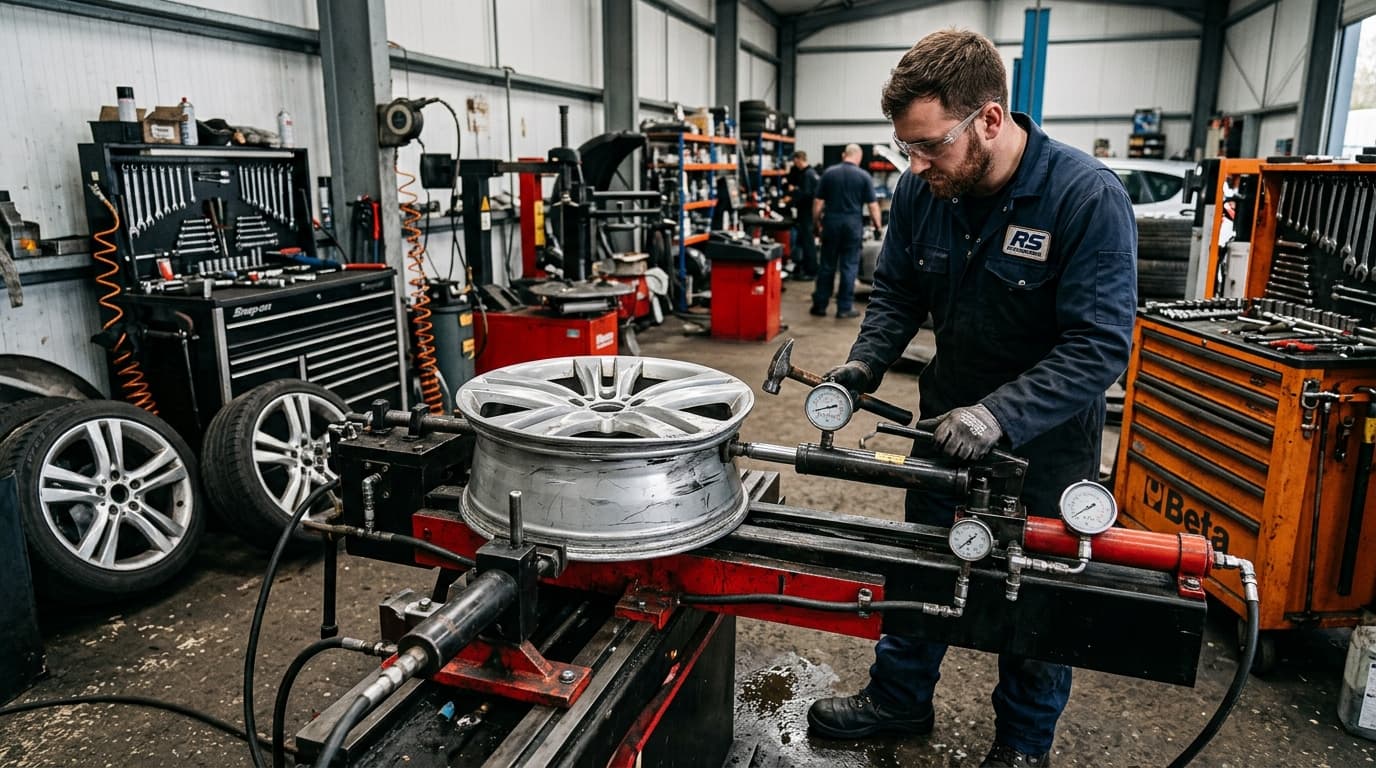
South Africa's roads are among the toughest in the world on your wheels. Between potholes on the N1, construction debris in the Northern Suburbs, and the occasional unavoidable kerb strike, bent and buckled rims are one of the most common repair jobs we see at Speedline Mags. The good news? Rim straightening in South Africa is a well-established service — and in most cases, a bent rim can be restored to factory spec at a fraction of the cost of replacement.
This guide covers everything you need to know: how rim straightening works, when it's safe (and when it isn't), what to expect to pay, and how to spot quality workmanship.
What Is Rim Straightening?
Rim straightening — sometimes called wheel straightening or bent rim repair — is the process of using hydraulic pressure and precision tooling to restore a deformed alloy wheel back to its original, round profile.
When your wheel hits a pothole or kerb at speed, the force causes the metal to deform. This deformation can affect the barrel (the inner edge where the tyre seats), the lip (the visible outer edge), or in severe cases, the whole wheel face. The result is typically:
- A visible wobble or vibration at highway speeds
- Tyre bead failure, leading to a slow leak or sudden loss of pressure
- Uneven tyre wear over time
- Steering pull or instability
Rim straightening addresses these issues by carefully applying controlled hydraulic force to push the metal back into shape. Done properly on a quality CNC straightening lathe, the process is accurate to fractions of a millimetre.
How Does the Rim Straightening Process Work?
At a specialist shop like Speedline Mags in Parow, the rim straightening process follows a structured sequence to ensure safety and accuracy:
1. Initial Assessment
The wheel is inspected visually and placed on a wheel balancing machine or diagnostic jig to measure the degree of runout (how far out of true the wheel is). A runout of more than 1.5mm typically causes noticeable vibration. We check:
- The lateral runout (side-to-side wobble)
- The radial runout (up-and-down deviation)
- The structural integrity of the wheel — cracks, stress fractures, or weld failures
2. Tyre Removal
The tyre must be removed before any straightening can take place. Trying to straighten a mounted tyre risks damaging the tyre bead and creates inaccurate results.
3. Hydraulic Straightening
The wheel is placed on a specialist hydraulic straightening rig — at Speedline we use a CNC straightening machine that applies measured pressure at precise points. The technician works incrementally, applying pressure and checking the profile repeatedly. This is skilled work that requires experience to avoid over-correcting or introducing new stress points.
4. Post-Straightening Inspection
After straightening, the wheel is checked again on the jig. Runout is measured to confirm it falls within tolerance. Most OEM manufacturers specify a maximum total runout of 1.0–1.5mm for road use.
5. Crack and NDT Check
For any wheel that has taken a significant impact, we recommend a non-destructive testing (NDT) inspection using dye penetrant or magnetic particle testing to check for hairline cracks that aren't visible to the naked eye. This is a critical safety step.
6. Tyre Refitting and Balancing
Once the wheel passes inspection, the tyre is refitted and the wheel-tyre assembly is balanced on a dynamic balancing machine.
Is Rim Straightening Safe?
This is the most important question — and the honest answer is: it depends on the severity and location of the damage.
When Rim Straightening IS Safe
- Mild to moderate bends on the barrel or lip — these are the most common type of pothole damage and respond well to straightening
- Single-point impacts where the deformation is localised
- Wheels with no cracks confirmed by NDT testing
- Alloy wheels (aluminium alloys respond well to cold straightening up to a point)
When Rim Straightening Is NOT Safe
- Cracked wheels — a crack in the structural face or spoke area is a hard stop. A cracked wheel must be replaced. No amount of welding or patching makes a cracked wheel safe for road use.
- Severely buckled wheels where the deformation exceeds the metal's elastic recovery limit — over-straightening creates internal stress fractures
- Wheels that have been straightened multiple times — metal fatigue accumulates with each repair cycle
- Steel wheels — while steel can be straightened with heat, alloy wheels should never be heated during straightening as this destroys their structural properties
At Speedline Mags we are transparent about this. If a wheel is not safe to repair, we will tell you — and we can help you source an OEM or aftermarket replacement at a fair price.
Rim Straightening Cost in South Africa: 2026 Price Guide
Pricing for rim straightening in South Africa varies depending on wheel size, the severity of the damage, and the shop's equipment and expertise. Here's a realistic guide for Cape Town:
| Damage Level | Typical Cost (per wheel) | |---|---| | Minor lip/barrel bend (15–17") | R450 – R750 | | Moderate buckle (17–19") | R750 – R1,100 | | Severe buckle (19–22") | R1,100 – R1,800 | | NDT inspection (optional add-on) | R200 – R350 | | Tyre removal and refit | R150 – R250 | | Dynamic wheel balancing | R80 – R150 |
Important caveat: very cheap rim straightening (under R400) usually means basic equipment and inexperienced technicians. Getting it wrong the first time means you'll pay again — or worse, end up with a safety issue.
If your wheel also needs refurbishment (powder coating, diamond cut finish, or a colour change), that's quoted separately. See our complete wheel repair cost guide for full pricing across all services.
How to Spot a Quality Rim Straightening Job
Not all rim straightening is equal. Here's what separates professional work from a quick fix:
What to Look For
CNC or laser-guided equipment — modern straightening machines use computerised measurement to achieve accurate results. Ask the shop what equipment they use.
Pre and post runout measurements — a reputable shop will show you the measured runout before and after the repair. This is your proof the wheel is within spec.
NDT crack testing — especially important for wheels that took a hard impact. Any shop that skips this step on a damaged wheel is cutting corners.
Tyre removed before straightening — this is non-negotiable for accurate results.
Wheel balancing included or offered — a straightened wheel needs to be rebalanced. If the shop quotes for straightening only and doesn't mention balancing, factor that cost in.
Red Flags
- Shops that hammer out bends by hand (hand-beating can create localised stress and is not precise enough for road-safe results)
- No measurement data offered before or after
- Same-day turnaround promised for severe damage (quality straightening takes time)
- No mention of crack checking for impact-damaged wheels
Rim Straightening vs Wheel Replacement: Which Is Better?
For many drivers, the instinct when they see a badly bent wheel is to go straight to replacement. But the math often tells a different story.
A set of OEM alloy wheels for a BMW 3 Series or Mercedes C-Class can cost anywhere from R8,000 to R25,000+ depending on the model and spec. A single replacement alloy for a VW Polo GTI or Toyota Hilux is typically R2,500–R6,000 per wheel.
Professional rim straightening at R600–R1,100 per wheel is a compelling alternative — provided the wheel passes NDT testing and the damage is within repair tolerance.
The key questions to ask:
- Is the wheel cracked? If yes, replace it. Full stop.
- Has it been repaired multiple times? If yes, replacement is the safer long-term choice.
- Is the damage to the face or spokes? Structural face damage is harder to repair safely than barrel/lip damage.
- Is it a rare OEM wheel you can't easily replace? Repair is often the only option to maintain originality.
For a full breakdown, see our wheel repair vs replacement decision guide.
Common Cars We See for Rim Straightening in Cape Town
VW Polo and Golf
The Polo Vivo and Polo GTI are Cape Town's most popular cars — and their low-profile tyres offer minimal cushioning against pothole impacts. 16" and 17" alloys on Polos and Golfs are among the most commonly straightened wheels we see. See our VW wheel repair guide for more.
Toyota Hilux and Fortuner
Bakkie owners in the Northern Suburbs and Somerset West area often run larger 17"–18" alloys that take a beating on farm roads and construction sites. Hilux rims respond well to straightening in most cases. More on Toyota wheel repair here.
BMW 3 Series and X3/X5
BMW alloys are expensive to replace — and often repairable. The 18" and 19" staggered fitments on 3 Series and X3 models are among the most popular wheels we straighten and refurbish. See our BMW wheel repair guide.
Mercedes-Benz C-Class and GLC
AMG-style wheels on C-Class and GLC models are particularly vulnerable to pothole damage given their low-profile rubber. Our Mercedes wheel repair guide covers the most common scenarios.
Ford Ranger
South Africa's best-selling vehicle for years running — the Ranger's wheels see plenty of abuse. Read our Ford Ranger wheel repair guide for Ranger-specific advice.
Why Potholes Are Getting Worse — and What It Means for Your Wheels
South African roads have deteriorated significantly over the past decade. SANRAL and municipal road maintenance budgets have been under pressure, and the result is visible on every major route in Cape Town: the N1 through the Huguenot Tunnel approach, Main Road in Parow, Voortrekker Road through Bellville, and countless side streets across the Northern Suburbs.
The physics is straightforward: a wheel travelling at 80–100km/h into a pothole experiences a sudden impulse load that can be 5–10x the static weight of the vehicle. Low-profile tyres (45 series and below) provide almost no cushioning, transmitting virtually the full load directly to the alloy. The result is typically a barrel bend on the inner or outer edge of the wheel, sometimes combined with a cracked tyre bead.
Prevention helps — see our guide on protecting your wheels from pothole damage — but realistically, if you drive in Cape Town regularly, bent rims are a matter of when, not if.
Rim Straightening at Speedline Mags: What to Expect
Speedline Mags is based in Parow, Cape Town, and has been specialising in alloy wheel repair and refurbishment for years. We serve drivers from across the Northern Suburbs — Bellville, Durbanville, Parow, Goodwood — as well as Blouberg, Table View, Somerset West, and beyond.
Our rim straightening service includes:
- Full visual and measured inspection before work begins
- CNC hydraulic straightening on precision equipment
- Post-repair runout measurement and documentation
- NDT crack testing on request (strongly recommended for impact-damaged wheels)
- Tyre removal and refit
- Dynamic wheel balancing
Turnaround time: most single-wheel repairs are completed within 1–2 working days. More complex or multiple-wheel repairs may take 2–3 days.
What to bring: just the affected wheel (or the full car if you'd prefer us to assess everything). No appointment needed for a quote — walk in and we'll assess the wheel on the spot.
Frequently Asked Questions
Can any bent rim be straightened? No. Cracked wheels, severely buckled wheels beyond the metal's recovery limit, and wheels with structural face or spoke damage are not safe to straighten. We will always advise you honestly.
Does rim straightening affect wheel warranty? If your wheels are still under a manufacturer or retailer warranty, check the terms before having any repair done. Most aftermarket warranties exclude pothole damage, but it's worth confirming.
Will the repair be visible? Straightening alone leaves no visible marks — the repair is entirely structural. If the wheel also needs cosmetic attention (scuffs, paint chips, corrosion), we can quote for refurbishment at the same time.
Can I drive on a slightly bent rim? We strongly advise against it. Even a small bend affects tyre seal, tyre wear, and handling. A slow leak from a compromised bead can fail suddenly at highway speed. Get it assessed and repaired promptly.
Do you offer warranty on rim straightening? Yes — we stand behind our work. If the repair fails under normal road use, bring it back and we'll assess it at no charge.
Get a Quote for Rim Straightening in Cape Town
If you've hit a pothole and suspect your rim is bent, the sooner it's assessed the better. A damaged rim left unattended can damage the tyre, affect your steering, and create a safety risk at speed.
Contact Speedline Mags in Parow today for a free assessment and quote. We'll inspect your wheel, tell you honestly whether it can be safely repaired, and give you a clear price upfront — no surprises.
Visit us in Parow, call us, or send us a message via our website. We're open Monday to Saturday and can usually assess your wheel while you wait.
Related guides: Wheel Straightening: How Bent Rims Are Fixed | Signs Your Wheels Need Professional Repair | Wheel Repair vs Replacement: Making the Right Decision