
Mobile vs Workshop Wheel Repair: Which is Better for Your Mags?
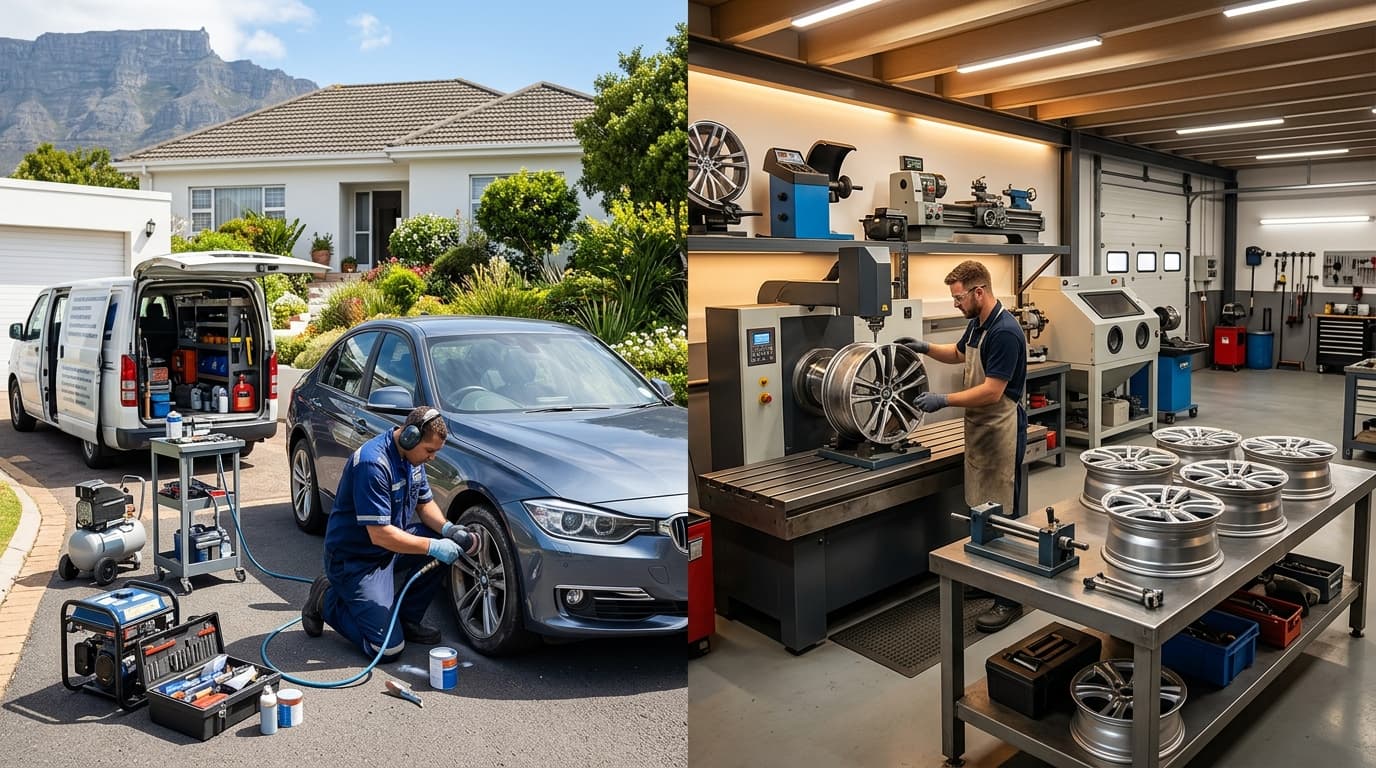
If you've recently scraped your alloys on a kerb or taken one pothole too many on the N1, you've probably started searching for wheel repair options — and quickly discovered there are two distinct routes: mobile mag repairs and a dedicated workshop visit. Both have their advocates, and both have genuine strengths. But they're not interchangeable, and choosing the wrong one can cost you more in the long run.
This guide breaks it down honestly, covering quality, types of damage, cost, turnaround time, and when each option actually makes sense for Cape Town drivers.
What Are Mobile Mag Repairs?
Mobile wheel repair services come to you. A technician arrives at your home, office, or parking lot with a van stocked with portable tools — typically a wheel sander, filler compounds, portable spray equipment, and in some cases a small curing lamp.
The appeal is obvious: no driving around Parow with a scraped rim, no booking a workshop slot, no arranging alternative transport. You book, they arrive, they fix.
But mobile mag repairs are a relatively limited service by nature. The equipment is portable, which means it's also compact and constrained. What they can do well, they do quickly and conveniently. What they can't do, they simply cannot replicate on a driveway.
What Happens in a Wheel Repair Workshop?
A proper wheel repair workshop — like Speedline Mags in Parow, Cape Town — is set up with industrial-grade equipment: hydraulic wheel straightening presses, lathe machines for diamond cut refurbishment, full blast booths, powder coating ovens running at controlled temperatures, and multi-stage quality checks throughout the process.
Workshop repairs are not faster, but they are deeper. The wheel comes off the car, is stripped down, and is treated as a standalone component. Every stage — from damage assessment to finishing — happens under controlled conditions with professional tools that simply cannot fit in a van.
Types of Damage: What Each Can Handle
This is arguably the most important factor in your decision. Not all wheel damage is equal, and the repair method must match the damage type.
What Mobile Repairs Can Handle Well
- Minor kerb rash and scuffing on the face or lip of the wheel
- Small paint chips and surface scratches
- Cosmetic touch-ups where colour matching is sufficient and the structural integrity is intact
- Light corrosion on the surface coating before it penetrates deeper
These are the scenarios where mobile mag repairs shine. If your wheel looks rough but structurally it's fine, a skilled mobile tech can make it presentable without you moving the car.
What Requires a Workshop Visit
- Buckled or bent rims — straightening requires a hydraulic press and precise measurement tools
- Cracked wheels — alloy welding and structural repair demand a controlled environment and specialist equipment
- Diamond cut (DC) finish restoration — this requires a CNC lathe to machine the face of the wheel back to its original machined aluminium finish; no mobile service can replicate this
- Full powder coat refurbishment — the multi-stage process (strip, blast, prime, coat, cure) requires an oven and blast booth
- Deep corrosion that has penetrated through the coating into the alloy substrate
- Multiple wheels requiring consistent colour matching across the set
If your car has DC-finish wheels — common on BMW, Mercedes-Benz, Audi, and many VW models — and the lacquer is peeling or the finish is damaged, mobile repair is not a viable option. You need a workshop with a lathe. Read our full guide on diamond cut wheel repair for more detail on this process.
Quality Comparison: The Honest Verdict
This is where opinions get heated, but the answer is fairly objective: workshop repairs produce higher-quality, longer-lasting results for all but the most minor cosmetic damage.
Here's why:
Surface preparation is the foundation of any lasting finish. In a workshop, wheels are chemically stripped, blasted, and primed before any coating is applied. On a driveway, prep is limited — the tech sands the affected area and feathers it into surrounding paint. The result can look great initially but may not last as long, especially given South Africa's sun, UV exposure, and road conditions.
Colour matching is significantly more accurate in a workshop. Powder coating eliminates the challenge entirely — it's a factory-equivalent process. Spray matching in the field depends on the tech's skill and available stock, and exact OEM colour matches can be difficult to achieve consistently.
Structural repairs cannot be compromised. A buckled wheel straightened on a hydraulic press with runout measured on a lathe is a precise, quantifiable repair. There is no mobile equivalent.
That said, for truly minor cosmetic work, a skilled mobile technician can deliver a result that's visually excellent — especially for solid colour wheels where touch-in blending works well. The gap in quality narrows significantly for smaller, contained damage.
Cost Comparison: Mobile vs Workshop
Mobile mag repairs are generally cheaper per wheel for cosmetic work. You're paying for convenience and a lower overhead operation.
Rough price ranges in Cape Town for 2026:
| Repair Type | Mobile | Workshop | |---|---|---| | Minor kerb rash (single wheel) | R350–R600 | R600–R950 | | Full cosmetic refurbish (single wheel) | R700–R1,200 | R1,000–R1,800 | | Diamond cut refurbishment | Not available | R1,200–R1,900 | | Buckled rim straightening | Not available | R800–R1,500 | | Full powder coat (single wheel) | Not available | R900–R1,600 | | Full set of 4 powder coat | Not available | R3,200–R5,500 |
These are indicative ranges — actual quotes depend on wheel size, damage severity, and the specific service provider. For a detailed breakdown, see our wheel repair cost guide for South Africa.
The apparent cost saving from mobile repairs can erode quickly if the finish fails sooner and the wheel needs redoing — or if the repair doesn't hold and the job gets handed to a workshop anyway. For structural issues, there is no mobile option at all.
Turnaround Time: Speed vs Depth
Mobile repairs win on speed for simple work. A mobile tech can typically complete a cosmetic repair on-site in 1–3 hours, and you're back on the road the same day.
Workshop repairs take longer:
- Cosmetic refurbishment: 1–3 days (allow time for prep, coating, and curing)
- Diamond cut: 2–4 days
- Straightening + refinish: 2–4 days
- Full powder coat set: 3–5 days
At Speedline Mags in Parow, we do our best to minimise turnaround without cutting corners on curing time or quality checks. For many Northern Suburbs customers in Bellville, Durbanville, and Tygerberg, dropping wheels in early in the week means collecting them ready for the weekend.
Convenience: Mobile Clearly Wins Here
There's no contest on convenience. Mobile repairs require zero disruption to your schedule. The tech comes to you, does the work, and leaves. You don't need to arrange a lift, make two trips to a workshop, or clear your diary.
This matters. For busy professionals, parents, or anyone who simply can't go without their car for multiple days, mobile has a real practical advantage — assuming the damage is within the scope of what can be done well on-site.
When to Choose Mobile Mag Repairs
Mobile is the right call when:
- The damage is purely cosmetic — light kerb scrapes, minor scuffs, surface scratches
- The wheel finish is a solid painted colour (not diamond cut, not highly polished)
- You need a quick fix before selling the car or for a visual touch-up
- Time and convenience are your primary constraints
- You've got a single wheel with contained, minor damage
When to Choose a Workshop
Choose a workshop when:
- You have DC (diamond cut) or polished finish wheels that need restoration
- The rim is buckled, bent, or out of round
- There is a crack or structural damage
- Multiple wheels need matching refinishing
- Corrosion has gone beyond the surface coating
- You want the repair to last — properly
- You're dealing with high-end wheels on a premium vehicle (BMW, Mercedes, Audi, Porsche)
For wheel damage on vehicles like the BMW 3 Series, VW Golf, or Toyota Fortuner — where OEM finish quality matters — a workshop is almost always the right choice. See our specific guides for BMW wheel repair and VW Polo and Golf wheel repair if you're driving one of these.
A Note on "Too Good to Be True" Mobile Pricing
If a mobile operator is quoting well below market rate — say R200 for a kerb scrape — be cautious. Low pricing can mean rushed prep (the most common cause of paint peeling within months), cheap filler products, or a colour match that looks right in the shade of your driveway but wrong in sunlight. Our guide on how to spot a badly repaired alloy wheel covers what to look for after any repair.
The Bottom Line
Mobile mag repairs and workshop repairs are not competitors in the same space — they serve different needs. Think of it this way:
- Mobile = convenient, cost-effective cosmetic fix for minor damage
- Workshop = the right tool for structural repairs, premium finishes, and results that last
If you're unsure which applies to your situation, the honest answer is to get a workshop assessment first. A reputable shop will tell you if your damage genuinely warrants workshop-level treatment or if a mobile operator could do the job. At Speedline Mags, we give straight answers — including when the work is outside our scope.
Talk to Speedline Mags About Your Wheels
Based in Parow and serving the Cape Town Northern Suburbs — including Bellville, Durbanville, Tygerberg, and beyond — Speedline Mags specialises in alloy wheel repair, diamond cut refurbishment, powder coating, and rim straightening.
If you're weighing up your options after some wheel damage, contact us for a no-obligation assessment. We'll tell you exactly what's needed and give you a clear quote.
Speedline Mags | Parow, Cape Town | Wheel repair, refurbishment & powder coating specialists