
Mobile Mag Repairs in Cape Town: How It Works and What to Expect
Scratch your rim reversing out of a parking lot in Bellville. Catch a pothole at speed on the N1. Scrape the kerb dropping someone in Parow. It happens to the best of us — and in Cape Town, it happens often. The question is: what next?
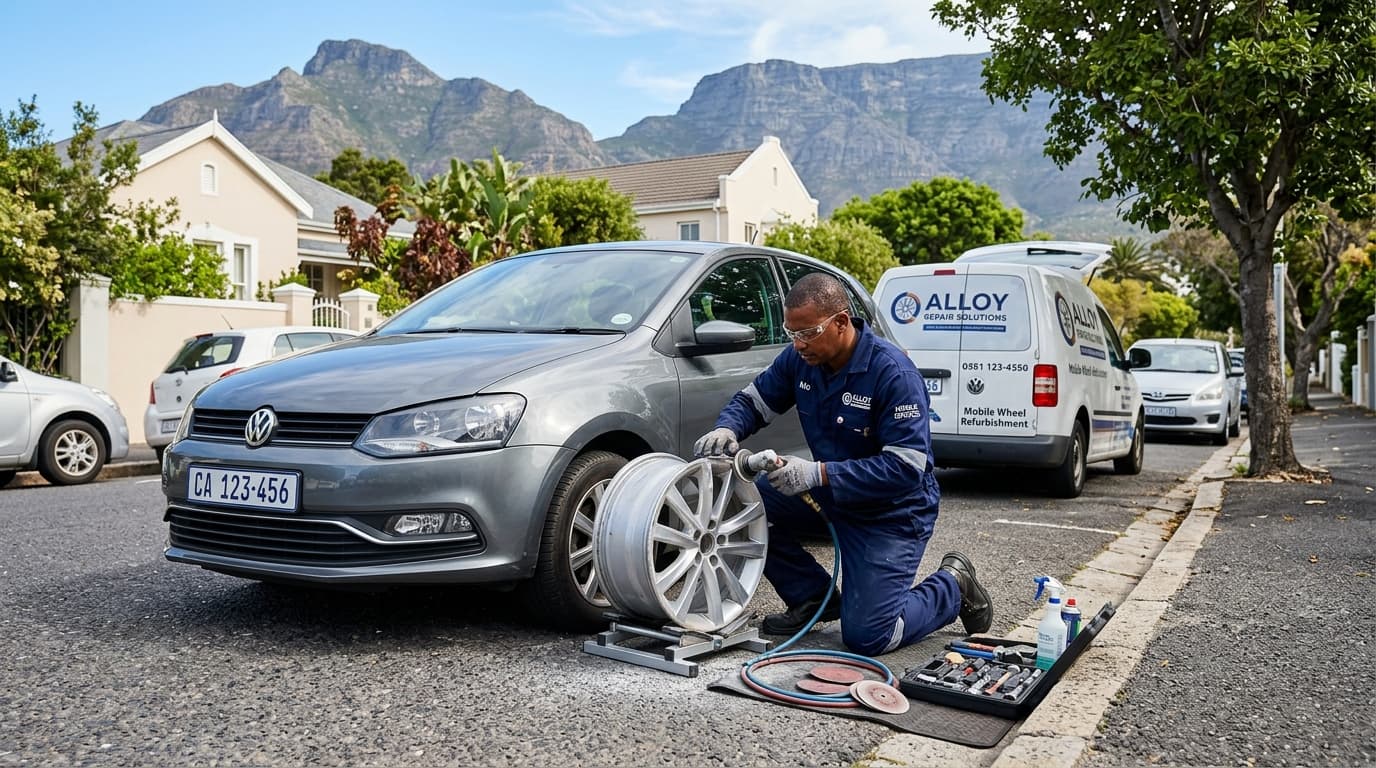
For a long time, the only option was booking your car into a wheel repair workshop, leaving it for a day or two, and arranging a lift back. Mobile mag repairs have changed that. A skilled technician comes to you — at home, at work, or wherever your car is parked — and fixes the damage on-site. No towing. No disrupting your day.
Here's how mobile mag repairs actually work, what types of damage can and can't be fixed on-site, how the costs compare, and what to look for when choosing a mobile repair service in Cape Town.
What Is Mobile Mag Repair?
Mobile mag repair is exactly what it sounds like: a wheel and mag repair technician travels to your location with a portable workshop — the tools, compounds, finishes, and equipment needed to fix your damaged alloy wheels without you having to drive anywhere.
The technician assesses the damage on arrival, carries out the repair, and typically finishes within one to three hours depending on the number of wheels and complexity of the work. Your car stays parked throughout.
Mobile services are particularly well suited to cosmetic and surface-level repairs — kerb rash, scuffs, light gouges, and paint or lacquer damage. For more serious structural issues, you'll still need a fully equipped workshop.
What Damage Can Be Fixed On-Site?
Not every type of wheel damage is suitable for mobile repair. Here's a clear breakdown:
On-Site Repairs: Usually Possible
Kerb rash and curb scrapes — The most common reason people call a mobile repair service. The outer lip or face of the wheel picks up scuffs and gouges from brushing a kerb. These can be filled, sanded, primed, and refinished on-site to a very high standard.
Surface scratches and paint damage — Chips, scratches, and faded lacquer on the wheel face can be touched up and resealed during a mobile visit.
Light corrosion — Early-stage oxidation and pitting on the wheel surface can be treated and refinished on-site before it spreads.
Single-wheel cosmetic refurbishment — If one wheel is noticeably different from the others — older, scratched, or previously repaired to a lower standard — a mobile technician can blend it to match.
Workshop Required: Not Suitable for Mobile
Structural cracks — A cracked alloy wheel is a safety issue and needs welding or specialised repair in a workshop environment. Mobile kits don't carry welding equipment capable of properly repairing a structural crack. Read more: Cracked Alloy Wheel Repair: What You Need to Know
Bent or buckled rims — Rim straightening requires a hydraulic press and wheel lathe. These are fixed, heavy machines — not portable equipment. If your wheel is bent, you need a workshop. See our guide on wheel straightening and bent rim repair.
Diamond cut finish repairs — The diamond cutting process uses a CNC lathe to machine the wheel surface to a precise mirror finish. This cannot be replicated with portable equipment. Learn more about diamond cut refurbishment.
Full powder coating — Powder coating requires a spray booth, curing oven, and controlled environment. Not possible on-site. More on this: Powder Coating Wheels: Complete Guide.
Multiple severely damaged wheels — Repairing four heavily damaged wheels on-site in a single session is logistically challenging. A workshop visit is usually faster and more cost-effective for high volumes of damage.
How Does the Mobile Repair Process Work?
Here's a typical mobile mag repair visit, step by step:
1. Assessment and quote The technician arrives and inspects the wheel damage under good light. They'll confirm what can be fixed on-site and give you a final price. Some operators quote over photos in advance; others prefer to see the damage in person before committing to a price.
2. Wheel prep The area around the wheel is protected. The damaged section is cleaned, degreased, and lightly abraded to create a mechanical key for the repair material.
3. Filling and shaping Deep gouges and chips are filled with an automotive-grade filler compound. Once cured, the area is shaped and feathered to blend with the surrounding surface.
4. Priming and painting A primer coat is applied to seal the repair. Then colour-matched paint is applied — either by brush (for very small areas) or a portable spray system. Getting the colour right matters enormously here. A good technician carries a comprehensive range of wheel paint colours and mixes to match.
5. Lacquer and finishing A clear lacquer coat is applied for protection and sheen. Some mobile technicians also apply an infrared curing lamp to speed up the process and harden the finish faster.
6. Inspection The finished repair is reviewed with you before the technician packs up. Most reputable operators will redo anything that isn't up to standard before leaving.
Total time on-site: 1 to 2 hours per wheel for typical kerb rash repair.
Mobile Mag Repair vs Workshop: Which Is Better?
Both approaches have their place. Here's an honest comparison:
| | Mobile Repair | Workshop | |---|---|---| | Convenience | Excellent — come to you | Requires drop-off | | Scope of repairs | Surface and cosmetic only | Full range including structural | | Finish quality | Good (varies by operator) | Best possible | | Turnaround | Same day, while you wait | Usually 1–2 days | | Cost | Slightly higher per wheel | More competitive for multiple wheels | | Diamond cut | Not available | Available | | Powder coating | Not available | Available |
For a single scuffed wheel that you want sorted quickly without taking time off work, mobile repair is often the better choice. For multiple damaged wheels, structural repairs, or premium finishes, a workshop visit will give you a better result. Read the full comparison: Mobile Wheel Repair vs Workshop.
How Much Does Mobile Mag Repair Cost?
Pricing for mobile mag repairs in South Africa typically runs R400 to R900 per wheel for standard kerb rash, depending on the severity of the damage and the operator. Some mobile operators charge a call-out fee on top of the repair cost, usually R100 to R200.
Factors that affect pricing:
- Severity of damage — A light scuff costs less than a deep gouge with removed material
- Wheel size — Larger diameter wheels take longer to work on
- Finish type — Metallic and custom colours require more skill and time
- Number of wheels — Some operators offer a discount for multiple wheels
- Travel distance — Call-out fees may apply if you're outside the technician's usual area
For context, replacing a single alloy wheel — even a standard fitment — typically costs upwards of R2,000 to R5,000+ for most passenger vehicles in South Africa. Quality mobile repair, done properly, is almost always more cost-effective. More on the maths: Wheel Repair vs Replacement: Making the Right Decision.
What to Watch Out For With Mobile Repair Services
Not all mobile repair operators deliver the same quality. A few things to check before you book:
Colour matching — Ask the operator how they match your wheel colour. Cheap kits use limited pre-mixed colours that rarely match well. A good technician either mixes to match or carries an extensive range of automotive wheel paints.
Finish durability — Ask what type of lacquer they use and whether it's UV-stabilised. Cheap lacquer will fade, yellow, or peel within months.
Structural safety — A reputable mobile technician should tell you clearly if damage is beyond cosmetic repair and needs a workshop. If someone is willing to patch over a crack without flagging it as a structural issue, walk away.
Photos of previous work — Ask to see examples. The wheel lip and edge should blend seamlessly after a quality repair, with no visible demarcation between repaired and original surfaces.
Guarantee — Good operators stand behind their work. Ask whether they guarantee the repair and what happens if you're not satisfied.
Who Is Mobile Repair Best Suited For?
Mobile mag repair is a great fit if:
- You have one or two cosmetically damaged wheels (kerb rash, surface scuffs)
- You're working from home and want the repair done without leaving
- You drive a company car or leased vehicle and want a quick fix before a return
- You need a same-day solution and can't leave your car at a workshop
- You want to restore one damaged wheel to match the rest before a sale
It's less suitable if you need structural repairs, full refurbishment on all four wheels, or a diamond cut or powder coat finish.
Speedline Mags: Workshop and On-Site Options in Cape Town
At Speedline Mags in Parow, we offer both workshop-based refurbishment and guidance on mobile repair options for Cape Town drivers. Our workshop is equipped to handle everything from basic kerb rash to diamond cut finishes, structural welding, and full powder coating — the full range of what mobile operators can't do.
If you're unsure whether your damage is suitable for an on-site fix or needs proper workshop attention, we'll give you an honest assessment with no obligation. Many customers come to us after a mobile repair that didn't hold up, or where the colour match was visibly off. We'd rather help you make the right call upfront.
We serve the Northern Suburbs and wider Cape Town area — Parow, Bellville, Durbanville, Goodwood, and beyond. Whether you need a single wheel sorted or a full four-wheel refurbishment, get in touch with Speedline Mags for a quote. We'll tell you straight what your wheels need and what it'll cost.
Looking to understand wheel damage better before you book? Our guides on protecting your wheels from pothole damage and signs your wheels need professional repair are a good starting point.