
Mag Repairs: Complete Guide for South African Drivers
If you drive on South African roads, sooner or later you will need mag repairs. Between the legendary Cape Town potholes, aggressive kerbs on narrow suburban streets, and the brutal expansion joints on the N1 and N2, our wheels take a beating that European roads simply do not dish out. The good news is that most mag damage is repairable — and it costs a fraction of replacing a rim. The bad news is that mag repairs is one of those services where the gap between a cheap job and a proper job is enormous, and the wrong workshop can leave you with a wheel that looks decent in the parking lot but fails the first time you hit a pothole at 100 km/h.
This guide pulls together everything a South African driver needs to know before booking mag repairs. We'll cover what the term actually means, typical 2026 prices in rands, the techniques a professional workshop should be using, the warning signs of a bad repair, and how to decide whether a wheel is worth repairing at all. We're writing this from our workshop in Parow, Cape Town, where Speedline Mags has been refinishing and repairing wheels for drivers across the Northern Suburbs, City Bowl, and the Winelands for years. But the advice applies wherever you are in SA.
What "Mag Repairs" Actually Means
"Mag" is short for magnesium, but in modern South African usage the term is almost always used for alloy wheels — cast or forged rims made from an aluminium alloy. True magnesium wheels are rare and specialised. When someone says "I need mag repairs," they almost always mean alloy wheel repair.
Mag repairs is an umbrella term that covers a range of services, each addressing a different kind of damage:
Cosmetic repairs. This is the bread-and-butter work: kerb rash, scratches, minor chips in the clear coat, scuffed faces from parking mishaps. The wheel is structurally fine — the damage is skin deep. A proper repair involves sanding out the damage, filling where needed, priming, repainting in the original colour, and clear-coating. Done well, you cannot tell it happened.
Structural repairs. Buckles, bends, and flat spots from hitting potholes or debris. The wheel's geometry is no longer correct, which causes vibration at speed, pulls the alignment, and accelerates tyre wear. These repairs use hydraulic pressure, controlled heat, and precision measurement to return the rim to spec. Not every workshop can do this properly, and not every wheel is a candidate — we cover that below.
Corrosion repairs. White oxidation under the clear coat, bubbling around the bead area, pitting on the face. Common on older BMW, Mercedes and VW wheels, and on anything that has spent time near the coast. Proper corrosion repair means stripping the wheel back to bare metal, treating the aluminium, and refinishing from scratch — not just painting over it.
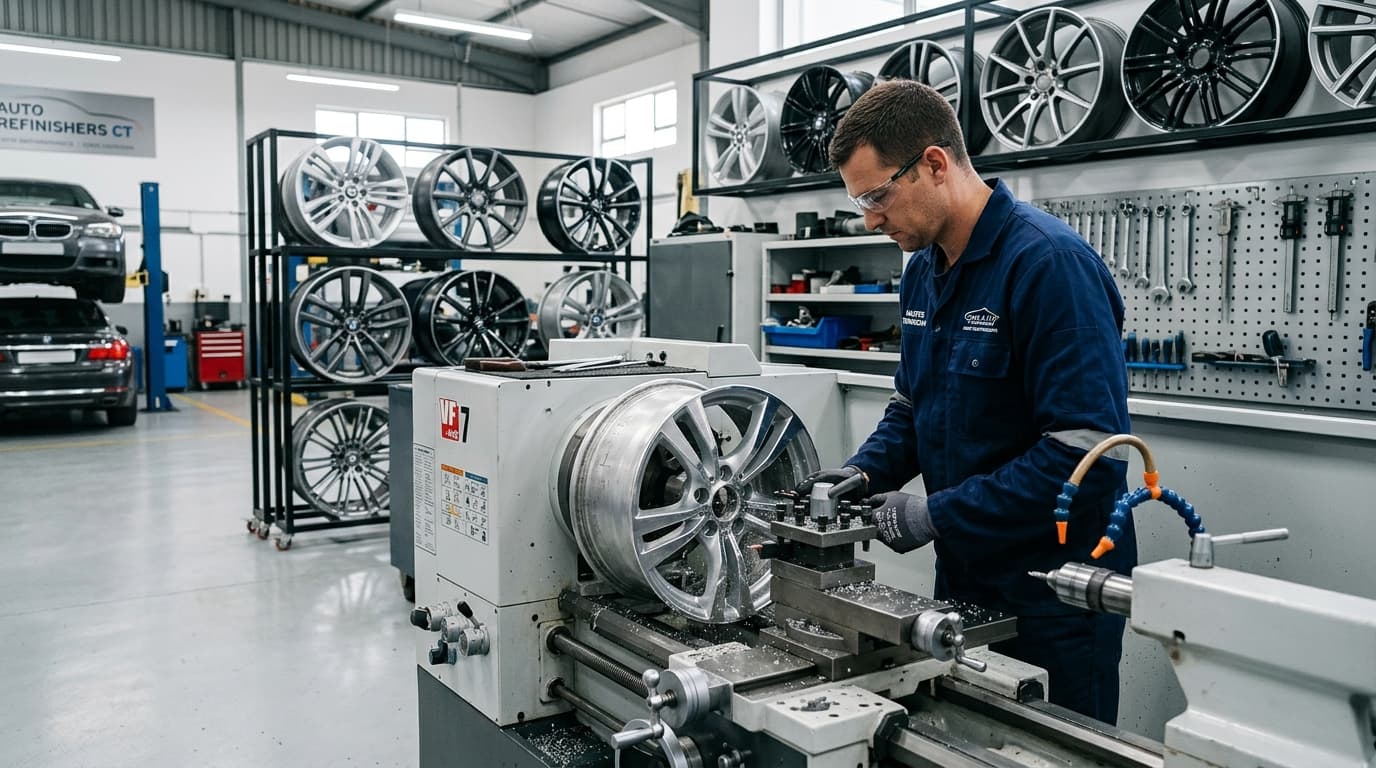
Diamond-cut refurbishment. A specialised technique where the face of the wheel is re-machined on a CNC lathe to restore the factory two-tone finish. Common on Audi, Mini, Range Rover, and newer VW wheels. Requires specific equipment that most general workshops don't have. If your wheels have that distinctive "machined" look with the bare aluminium grooves against painted pockets, you need diamond cut wheel refurbishment, not standard painting.
Full refurbishment. The whole package — strip, repair, refinish, in your choice of colour and finish. This is what most people actually want when they say "I want my mags done."
Understanding which category your wheel falls into is the first step, because the price, turnaround time, and even the choice of workshop all depend on it.
Mag Repairs Cost in South Africa: 2026 Price Guide
Let's talk money. Prices vary by workshop, wheel size, damage extent, and finish choice, but here are the realistic 2026 ranges you should expect for quality work in Cape Town and Johannesburg:
Standard cosmetic repair (single wheel): R650 – R1,200. Fixing kerb rash and minor scuffs, refinished in original colour, clear coated. Same-day or next-day turnaround.
Full refurbishment (single wheel): R1,400 – R2,500. Strip to bare metal, repair, prime, paint in chosen colour, clear coat. Typically 2 – 4 working days.
Set of four (full refurb): R5,200 – R9,000. Most workshops give a small discount for a full set.
Diamond cut refurbishment: R1,800 – R3,200 per wheel. Requires CNC lathe time, specialised clear coat.
Buckled rim straightening: R750 – R1,800 per wheel depending on severity.
Crack welding and repair: R1,200 – R2,500 per wheel, and only possible on certain cracks (see the structural section below).
Powder coating upgrade: Add R300 – R600 per wheel on top of standard refurbishment pricing. More durable than painted finishes.
Two-tone or custom multi-colour finish: Add R400 – R900 per wheel.
Be very suspicious of quotes well below these ranges. If someone is doing "mag repairs" for R350 a wheel, they are either spraying over the damage without proper prep, using cheap automotive paint that will chip and fade within months, or cutting corners that will show up in a few thousand kilometres. We've seen too many customers bring us wheels that have been "repaired" three times at cheap shops before finally coming to us to be stripped and done properly — and at that point they've paid more than if they'd just done it right the first time.
For a deeper breakdown of what goes into pricing, see our dedicated wheel repair cost guide for South Africa.
What Good Mag Repairs Actually Involves
Here's a walk-through of what should happen when you drop a damaged alloy wheel at a proper workshop. If a shop skips steps, it will show up later.
Inspection and assessment
The wheel gets inspected on a stand, sometimes with the tyre still fitted, sometimes after dismounting. A technician checks for cracks (especially around the inner barrel and spokes), buckles, corrosion under the lacquer, and previous repairs. On buckled wheels, a runout gauge measures lateral and radial deviation — that's the number that tells us whether it's straightenable and how aggressive the process needs to be.
This is also where the workshop decides whether the wheel is safe to repair. A crack through a load-bearing area, a wheel that has been severely overheated, or one that has already been welded multiple times is a replace, not a repair. A workshop that agrees to "fix anything" without inspecting is a red flag.
Tyre removal and prep
Tyres come off. The wheel is cleaned, degreased, and any old weights and valve bits are removed. Media blasting or chemical stripping then takes the wheel back to bare aluminium — this is non-negotiable for full refurbs and corrosion work. Sanding over the old coat and respraying is the single biggest corner-cut in this industry.
Structural work (if needed)
If the wheel is buckled, it goes on a hydraulic straightening machine. The process uses controlled pressure, often with targeted heat (aluminium moves better warm), to bring the rim back within runout tolerance. A properly straightened wheel should be within 0.5 mm of true — you can feel the difference behind the wheel.
Cracks are a different story. A crack in a non-load-bearing area (like the outer lip) can sometimes be TIG-welded by a specialist, then machined smooth and refinished. A crack in a spoke or through the hub area is usually a write-off. Never accept a repaired wheel with a welded spoke crack unless the workshop has x-ray or dye-penetrant tested it — and even then, we'd replace it.
Surface prep and priming
Bare aluminium gets an etch primer that bonds chemically with the metal. Filler is applied where needed to rebuild kerb damage — done right, this is a skilled trade, not just "splodging on body filler." The filler is sanded smooth, then a high-build primer goes over the whole face to give a uniform base.
Colour and finish
Basecoat is applied in your chosen colour. This could be the original factory colour, a custom shade, a two-tone combination, or a specialty finish like anthracite or bronze. Most modern finishes are either painted (two-stage basecoat/clearcoat) or powder coated — which is more durable but limited in colour and finish options.
On diamond-cut wheels, the machining step happens after the base colour is applied. The face goes on a CNC lathe and the machinist takes a very fine cut across the face, exposing bare aluminium in the machined areas while leaving the paint in the pockets. Then a specialty clear coat — the kind that bonds to bare aluminium without bubbling — is applied. This is why diamond cut costs more: the equipment is expensive and the tolerances are tight.
Clear coat and cure
Clear coat is where cheap repairs fall apart first. A proper two-pack urethane clear, baked at 60 – 80°C, will last years. A single-pack lacquer from an aerosol can will yellow, peel, and crack within a year. Ask your workshop what clear coat they use — if they don't have a straight answer, walk away.
Balance and fitment
Tyres go back on, wheels are balanced (ideally on a road-force balancer for the straightened ones), and you drive away. A good workshop will also check for any bent studs or damaged hub surfaces before handing back the car.
How to Tell If You Need Mag Repairs
Some damage is obvious. Other kinds sneak up on you until the car is telling you there's a problem. Here's what to watch for:
Visible kerb rash. Scraped face or outer lip from a kerb strike. Cosmetic, but worth fixing before water gets under the clear coat and corrosion starts.
Vibration in the steering wheel. Especially between 90 and 130 km/h. Usually a balancing issue, but a buckled wheel will cause vibration that no amount of balancing fixes. If you've recently hit a pothole and then developed vibration, it's almost certainly structural.
Slow tyre leak. Air escaping around the bead area is often corrosion eating away the sealing surface. The tyre isn't the problem — the wheel is.
Pulling to one side. If the car pulls after a pothole strike, you may have a bent wheel affecting the effective geometry. Alignment won't fix a bent rim.
Uneven tyre wear. Feathering, cupping, or a single tyre wearing faster than the others can indicate wheel issues.
Bubbling or flaking clear coat. Cosmetic now, but will worsen. Address before it becomes a full refurb job.
Our guide on signs your wheels need professional repair goes into more depth on diagnosing these symptoms.
Mag Repairs Near Me: How to Choose a Cape Town Workshop
Typing "mag repairs near me" into Google will give you a dozen options in the Cape Town area, from one-man backyard operations to full-service workshops. Here's how to separate the good from the risky.
Visit in person before booking. A clean, organised workshop with proper equipment — booth, oven, CNC lathe for diamond cuts, hydraulic straightener — is a strong signal. Chaos, dust everywhere, and "we paint them out back" is not.
Ask about their clear coat system. Two-pack urethane with a heat cure is what you want to hear. Aerosol cans or "wet-on-wet lacquer" means you'll be back in a year.
Look at finished work on the rack. Not photos on Instagram — actual wheels ready for collection. Check the paint for orange peel, drips, pooling in the spokes, or overspray on the inside of the rim. Run a fingernail across the edge of a machined area on a diamond-cut wheel — it should be glass-smooth.
Check the warranty. A confident workshop offers at least 12 months on the finish. Six months is the bare minimum. No warranty at all is a no.
Ask about their process for buckled wheels. They should mention runout measurement, hydraulic straightening with heat, and a final runout check. "We hammer them straight" is both scary and true of some cheaper shops.
Look at their customer base. Workshops that regularly handle premium brands — BMW, Mercedes, Audi, Porsche, Range Rover — have usually invested in the equipment and skills needed for quality work, because those customers will not tolerate a rough job.
In Cape Town, you'll find decent workshops across Parow, Bellville, Durbanville, Brackenfell, Somerset West, and the Southern Suburbs. Speedline Mags is based in Parow, central to the Northern Suburbs and a short drive from the N1 if you're coming from the City Bowl, Stellenbosch, or further afield. If you're in the northern areas, our guides on wheel repair in Bellville, Table View and Blouberg, and Durbanville give area-specific advice.
Common Pitfalls (and How to Avoid Them)
After years in this trade, we've seen the same mistakes over and over. Here are the big ones:
Trusting cheap quotes. If it sounds too cheap, it is. A proper refurb takes labour, materials, and oven time. Someone quoting R400 a wheel is not doing what we're doing.
Letting a tyre shop "repair" mags. Fitment centres do a fine job with tyres and balancing. Most are not set up for proper mag repairs. They'll use filler and spray cans and the result will look OK for a few months.
Repairing a wheel that should be replaced. Cracks through the spokes, multiple previous repairs in the same area, severe overheating from a tyre fire — these are replacements, not repairs. A workshop willing to endlessly patch a dying wheel is doing you a disservice. Our repair vs replace guide covers this in detail.
Skipping the fourth wheel. If one wheel is damaged, people often repair just that one. Fine — but if the others are starting to show corrosion or tired finish, you'll end up with one pristine wheel and three tired ones. Consider doing the set.
Choosing the wrong finish for your driving. A gloss white wheel looks stunning on delivery day. After a Cape Town winter of brake dust and pothole grit, it looks tired. Satin anthracite hides wear far better. Matt black hides it best of all but shows scratches. Think about what you'll actually live with.
Mag Repairs FAQ
How long do mag repairs take? A simple cosmetic repair can be done in a day. A full refurbishment of all four wheels typically takes 3 to 5 working days. Diamond cut refurbishment takes longer — usually 4 to 7 days because of the multi-stage process. Rush jobs are sometimes possible for an extra fee.
Can all alloy wheels be repaired? Most can. Exceptions: wheels with cracks through load-bearing areas, wheels that have been repeatedly welded, wheels with severe internal corrosion that has eaten through the barrel, and wheels that have been overheated (usually from a tyre fire). A reputable workshop will tell you straight if your wheel is not safe to repair.
Will the repair be invisible? Done well, yes — especially on the outer face. Close inspection of a kerb rash repair might reveal very faint evidence, but casual observation will not. The key word is "well" — cheap repairs are usually very visible.
Will it affect my tyre warranty or insurance? Properly performed structural repairs by a reputable workshop should not affect anything. Very poor repairs, DIY welding, or wheels that have been straightened beyond their design tolerance could be flagged by an insurance assessor after a claim. Always keep records and invoices. Our insurance claims guide covers this in more depth.
Can I drive with a buckled wheel? Short distances at low speed to get to a repair shop, yes. Regular driving, no — the vibration is damaging your hub bearings, the misalignment is wearing your tyres, and you're losing control authority, especially in emergency braking or swerving.
Are painted or powder coated finishes better? Powder coating is more durable and more chip-resistant, but painted finishes give you a wider range of colours, effects (pearls, metallics), and the option of diamond cut. For daily drivers, powder coating is often the better choice. For show or enthusiast cars, paint usually wins on finish quality.
Do you repair steel wheels too? Some workshops do, but the economics rarely make sense. Steel wheels are cheaper to replace than refurbish in most cases. Our alloy vs steel guide explains the trade-offs.
How Speedline Mags Handles Mag Repairs
We run a full-service wheel workshop in Parow, Cape Town. That means in-house: inspection, tyre removal, media blasting, hydraulic straightening, crack assessment, filler work, priming, painting (booth and oven), powder coating, diamond-cut CNC machining, clear coating, balancing, and fitment. Everything happens under one roof, which keeps quality control tight and turnaround times predictable.
Most of our work is refurbishment and repair for Northern Suburbs drivers — Parow, Bellville, Durbanville, Brackenfell, Goodwood, Panorama, and Plattekloof — but we see customers from the City Bowl, the Winelands, and the Southern Suburbs regularly. We handle everything from daily-driver VW Polos and Toyota Hiluxes to show-car BMWs, Porsches, and Range Rovers. The principles are the same — the only thing that changes is the finish.
If you're weighing up mag repairs and want a straight assessment of whether it's worth it, bring your wheels in for a free inspection. We'll tell you honestly whether we'd recommend repair or replacement, what the realistic cost will be, and how long it will take. No hard sell, no surprises on the invoice.
Ready to Book Your Mag Repairs?
If your wheels have been collecting kerb rash, pothole damage, or corrosion, book a free inspection at Speedline Mags in Parow. We'll give you a proper assessment, a transparent quote, and the kind of finish that holds up to real South African roads.
Call us, WhatsApp us, or drop in during workshop hours — you can find our contact details and directions on the Speedline Mags website. We'll have your wheels looking right and driving right.