
Buckled Wheel Repair: Causes, Symptoms & Costs in South Africa
South African roads are rough. Between Cape Town's infamous pothole season, raised railway crossings, and the general abuse that bakkie and SUV wheels take on gravel roads, buckled wheels are one of the most common reasons drivers visit a wheel repair specialist. If your car vibrates at speed, pulls to one side, or your tyre keeps losing air for no obvious reason, a buckled wheel could be the culprit.
This guide covers everything you need to know about buckled wheel repair — what causes it, how to diagnose it, whether repair or replacement makes more sense, and what you should expect to pay in South Africa in 2026.
What Is a Buckled Wheel?
A buckled wheel (also called a bent rim or bent wheel) is an alloy or steel wheel that has been deformed out of its original round shape. Unlike a cracked wheel, which has structural fractures, a buckled wheel has been bent — usually from a sharp impact — so that it no longer runs true.
Alloy wheels are particularly susceptible because, while they're lighter and more aesthetically appealing than steel wheels, they're less forgiving when struck with force. The aluminium alloy can deform under impact, creating a flat spot or a lateral warp in the rim.
The deformation can occur in two directions:
- Radial buckle (vertical bend): The wheel is no longer perfectly round — it has a flat spot or a bump. You'll typically feel this as a rhythmic thumping or bouncing at low speeds.
- Lateral buckle (side-to-side bend): The wheel runs out of plane — it wobbles from side to side as it rotates. This causes handling issues and uneven tyre wear.
In many cases, both types occur together after a serious impact.
What Causes a Buckled Wheel?
Understanding the cause helps you prevent repeat damage and informs whether repair is worthwhile.
Potholes
The number one cause of buckled wheels in South Africa. Cape Town and surrounds — including the N1 through Parow and Bellville, the R300, and countless suburban streets — are riddled with potholes, especially after winter rains. When a tyre drops into a pothole at speed, the wheel rim absorbs enormous impact force in milliseconds. Low-profile tyres (common on modern sedans like the VW Polo GTI and BMW 3 Series) offer minimal cushioning, making the rim even more vulnerable.
Kerb Strikes
Misjudging a parking manoeuvre or clipping a high kerb is another common cause. This tends to produce lateral buckles and cosmetic damage to the outer lip. It's especially common in tight parking lots around the Northern Suburbs shopping centres.
Speed Bumps at Speed
Hitting a speed bump too fast — particularly the harsh flat-topped ones found throughout Cape Town suburbs — can transmit enough force to bend a rim, especially on heavier vehicles like the Toyota Hilux, Ford Ranger, or SUVs.
Railway Crossings and Road Obstacles
Poorly maintained level crossings and road obstacles can produce sharp impacts that rival pothole damage in severity.
Overloading
Consistently overloading your vehicle beyond its rated capacity increases tyre pressure and makes your wheels more vulnerable to buckle damage from normal road imperfections.
Symptoms of a Buckled Wheel
Catching a buckled wheel early means you can repair it before it causes secondary damage to tyres, wheel bearings, or suspension components. Watch for these warning signs:
Vibration Through the Steering Wheel
The most common symptom. A radially buckled wheel creates a rhythmic vibration that worsens at higher speeds — typically becoming noticeable from around 80 km/h. Unlike wheel imbalance (which usually presents as a shake at a specific speed range), buckle-related vibration tends to persist or worsen as speed increases.
Pulling to One Side
A laterally buckled wheel can cause your car to pull to one side, even after a wheel alignment. If your car drifts left or right and a fresh alignment doesn't fix it, a bent wheel could be the root cause.
Unexplained Tyre Pressure Loss
A buckled rim can break the airtight seal between the tyre bead and the rim. This causes a slow leak — not a blowout, but a tyre that needs topping up every few days. If your TPMS warning light keeps coming on or you're repeatedly inflating the same tyre, have the rim inspected.
Uneven Tyre Wear
A wheel that runs out of round or out of plane causes the tyre to wear unevenly. You might notice scalloping (cupped wear) or feathering on the tyre's contact patch. Left unchecked, this accelerates tyre replacement costs significantly.
Visible Damage
Sometimes you can see it. Look for a flat spot, a dent in the barrel, or a lip that's clearly bent out of shape. Subtle lateral buckles can be harder to detect visually and may only be confirmed on a wheel balancing machine.
How Is a Buckled Wheel Diagnosed?
At Speedline Mags in Parow, Cape Town, we use a combination of visual inspection and wheel balancing equipment to identify buckled wheels.
On the balancer: When a buckled wheel is spun on a balancing machine, you can observe the wobble directly. Skilled technicians can measure radial run-out (how much the wheel bounces up and down) and lateral run-out (how much it moves side to side) to assess the severity.
Run-out tolerances: Most manufacturers specify maximum run-out of 0.5–1.0mm for alloy wheels. Anything beyond 1.5–2mm is typically noticeable to drivers. Severe buckles of 3mm or more cause serious handling and tyre wear problems.
Can a Buckled Wheel Be Repaired?
In most cases, yes. Alloy wheel straightening is an established process that can restore a buckled rim to within manufacturer run-out tolerances. Here's how it works:
The Hydraulic Straightening Process
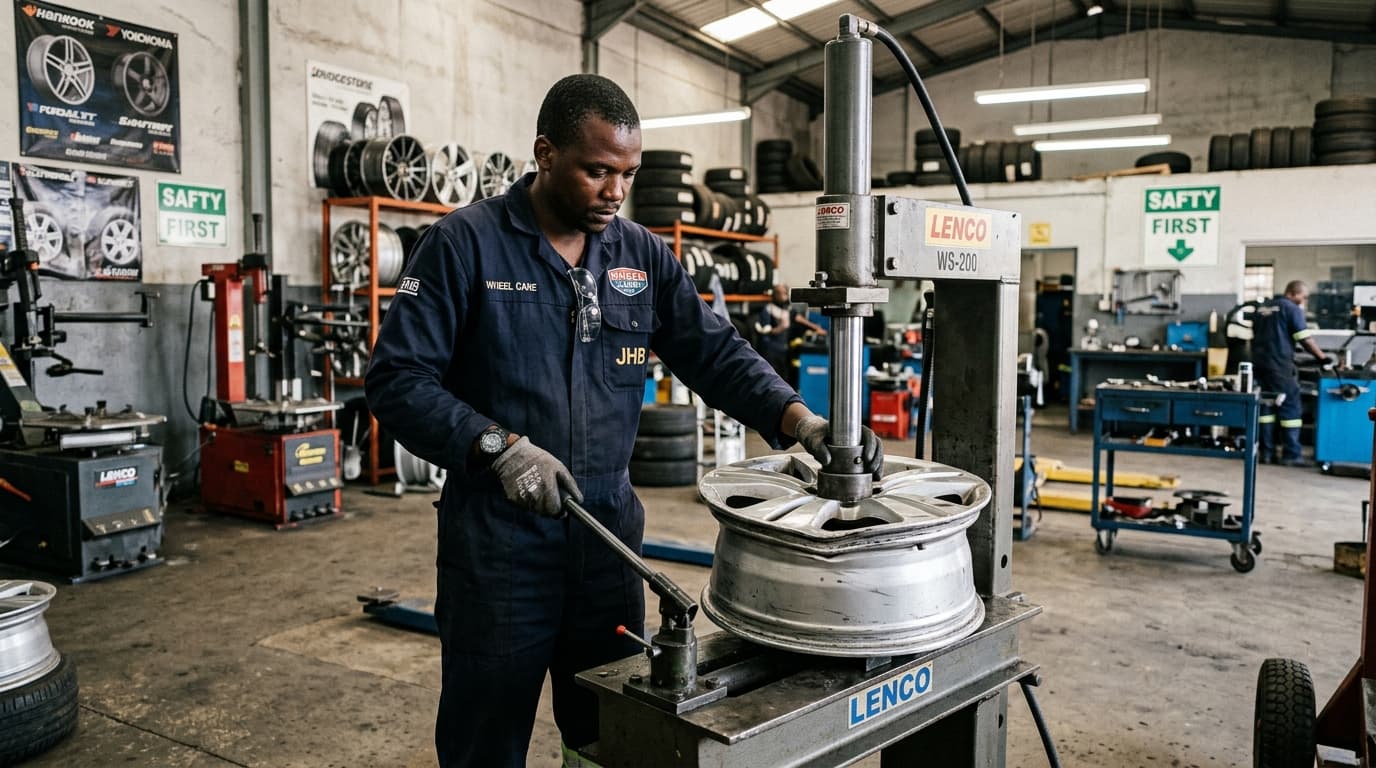
A specialist wheel repair shop uses a hydraulic press or a dedicated wheel straightening machine that applies precisely controlled force to the damaged area. The wheel is mounted, the buckled section is located, and pressure is applied gradually — heating may be used to improve the aluminium's malleability. This is a skilled process; too much force in the wrong direction creates a new problem.
At Speedline Mags, every straightened wheel is re-checked on the balancing machine after repair to confirm it meets run-out specifications before being returned to the customer.
When Repair Is Not Possible
Not every buckled wheel can be saved. Repair is generally not recommended when:
- There is a visible crack. Welding can sometimes address cracks, but a cracked wheel near a spoke or the bead seat is a safety-critical issue. See our guide on alloy wheel welding safety.
- The metal has fatigued or stretched excessively. Straightening a severely deformed section can over-stress the metal.
- The repair would compromise structural integrity. Safety always takes priority.
- The wheel has been repaired in the same area multiple times. Repeated stress in one zone weakens the alloy.
A reputable shop will tell you honestly when replacement is the better option. If you're unsure, read our wheel repair vs replacement decision guide for a detailed framework.
Buckled Wheel Repair Costs in South Africa (2026)
Pricing varies by severity, wheel size, and whether finish restoration is needed alongside the structural repair.
Straightening only (no refinishing):
- Small passenger car wheel (15"–17"): R500 – R900
- Larger alloy (18"–20"): R800 – R1,400
- Large SUV / bakkie wheel (20"+): R1,200 – R2,000+
Straightening + refinishing (powder coat or full refurbishment):
- Add R800 – R1,500 depending on finish type
These are indicative ranges. For an accurate quote, bring the wheel in for a no-obligation inspection — we can assess severity and confirm whether repair is viable before you commit.
Compare this to replacement: a single OEM alloy for a BMW 3 Series or VW Polo can cost R3,000 – R8,000 or more. Straightening, when possible, is almost always the more economical choice. For a broader look at repair costs, see our wheel repair cost guide for South Africa.
Does Insurance Cover Buckled Wheels?
Comprehensive motor insurance in South Africa can cover wheel damage, but it depends on your policy and the circumstances. Single-incident damage (e.g., hitting a pothole or a kerb) is more likely to be covered than general wear. You'll need to check your excess and whether the claim is worthwhile against your premiums. Read our detailed insurance claims guide for wheel damage for everything you need to know.
Repair vs Replace: Making the Right Call
Use this decision matrix to guide your choice:
| Factor | Lean Towards Repair | Lean Towards Replacement | |--------|-------------------|------------------------| | Severity | Minor to moderate buckle | Severe deformation or cracks | | Wheel age | Relatively new, good condition | Old, corroded, or previously repaired | | Cost vs new | Repair is <50% of replacement cost | Repair approaches replacement cost | | Safety assessment | Passes technician inspection | Structural compromise detected | | Finish | Can be refinished to match | Finish too damaged to restore |
For many drivers in Cape Town — especially those running premium alloys on BMWs, Mercedes-Benzes, or Audis — repair at a fraction of the replacement cost is a straightforward decision.
Preventing Buckled Wheels
You can't avoid every pothole, but you can reduce your risk:
Check tyre pressure regularly. Properly inflated tyres act as a buffer between the rim and road imperfections. An underinflated tyre offers less protection on impact and makes buckle damage more likely. For Cape Town conditions, monthly pressure checks are sensible.
Choose the right tyre profile. If you've lowered your car or fitted very low-profile tyres (e.g., 35 or 40 series) for aesthetics, understand that you've reduced your wheel's buffer zone. Consider whether the look is worth the added vulnerability on SA roads. See our tyre and wheel safety guide for more detail.
Slow down for potholes and speed bumps. When you see one coming, reducing speed significantly reduces the impact force your wheel must absorb. The energy in an impact increases with the square of velocity — halving your speed quarters the impact energy.
Avoid kerb strikes. Take parking slowly and use your mirrors carefully, particularly in tight spaces.
Inspect after a hard impact. If you hit something hard, don't wait for symptoms. Have the affected wheel checked — catching a minor buckle early is cheaper than dealing with tyre damage or bearing wear later.
Why Choose Speedline Mags for Buckled Wheel Repair?
Speedline Mags has been the Northern Suburbs' trusted wheel specialist for years, serving customers from Parow, Bellville, Durbanville, Goodwood, and beyond. Our approach to buckled wheel repair is straightforward: we assess honestly, repair professionally, and only return a wheel to you when it meets proper run-out tolerances.
We work on all vehicle types — from VW Polos and Toyota Hilux bakkies to BMW X5s and Porsche SUVs. Whether you need a single wheel straightened or a full set assessed after a serious pothole encounter, our team has the equipment and expertise to handle it.
We're located in Parow, Cape Town, and are accessible from the N1 and surrounding suburbs within minutes.
Final Thoughts on Buckled Wheel Repair
A buckled wheel is more than a cosmetic inconvenience — it affects your safety, tyre life, and fuel efficiency. The good news is that buckled wheel repair is almost always possible, cost-effective, and fast. Most straightening jobs are completed same-day or within 24 hours.
If you're experiencing vibration, pulling, or a slow tyre leak and suspect your wheel might be buckled, don't delay. Bring it in to Speedline Mags for a free visual assessment. We'll tell you exactly what's wrong and what it costs to fix it — no guesswork, no surprises.
Contact Speedline Mags via our website or phone to book your inspection. We're here to get your wheels running straight again.