
Bent Rim Repair: Should You Straighten or Replace Your Wheel?
South Africa's roads are unforgiving. From the pothole-riddled back streets of Parow to the uneven surfaces along the N1 through Bellville, Cape Town drivers know all too well the sickening clunk of a rim making hard contact with a crater in the tarmac. If you're reading this, chances are your steering wheel is shuddering, your tyre is slowly losing pressure, or you can see a visible kink in one of your wheels — and now you need to know: is bent rim repair the right move, or should you just replace it?
This guide gives you the full picture. We'll walk through what actually happens to a wheel when it hits a pothole, how technicians assess the damage, when straightening is structurally sound, when it isn't, and what to expect on the bent rim repair cost front in South Africa in 2026.
What Happens When a Rim Gets Bent?
When your tyre strikes a pothole or kerb at speed, the energy transfers almost instantly through the rubber and into the alloy. The rim, which is designed to flex slightly under normal load, gets hit with a force it wasn't designed to absorb in one sharp impact.
The result is usually one of three outcomes:
- A flat spot or lip distortion: The outer lip of the rim folds inward or outward slightly. This is the most common type of bent rim and is typically repairable.
- A mid-barrel buckle: The barrel of the wheel (the inner section) deforms. Less common, but still often repairable.
- A crack or fracture: The impact stress exceeds the alloy's tensile limit and the metal fractures. This is where the conversation shifts from repair to replace.
Most people can't tell the difference between these just by looking. A qualified wheel repair technician can spot it in seconds.
How Technicians Assess Bent Rim Damage
Before any repair begins, a proper workshop will mount the wheel on a spin balancer or dedicated wheel assessment jig to measure runout — that's the degree to which the wheel deviates from a perfect circle as it rotates. A brand-new wheel typically has less than 0.5mm of runout. Anything beyond 1.5–2mm is noticeable to the driver and anything over 3mm is causing vibration and uneven tyre wear.
The tech will also do a visual and tactile inspection for:
- Hairline cracks — often invisible unless you know what to look for. Even small cracks near the spokes or around the valve stem hole are serious.
- Corrosion within the bend — if the protective coating has failed and the bend has introduced moisture, the metal may be compromised.
- Previous repairs — a wheel that's been straightened once can often be straightened again safely, but repeated repairs weaken the alloy over time.
- Spoke stress marks — cracks often radiate from spokes before becoming visible on the rim face.
At Speedline Mags in Parow, every wheel goes through this assessment before any quote is given. There's no point quoting a repair on a wheel that can't safely be repaired.
When Is Bent Rim Repair Safe?
The short answer: bent rim repair is safe when the damage is limited to distortion of the rim lip or barrel, with no cracks present, and the wheel can be returned to within acceptable runout tolerances.
Here are the scenarios where repair makes clear sense:
1. Minor to Moderate Lip Damage
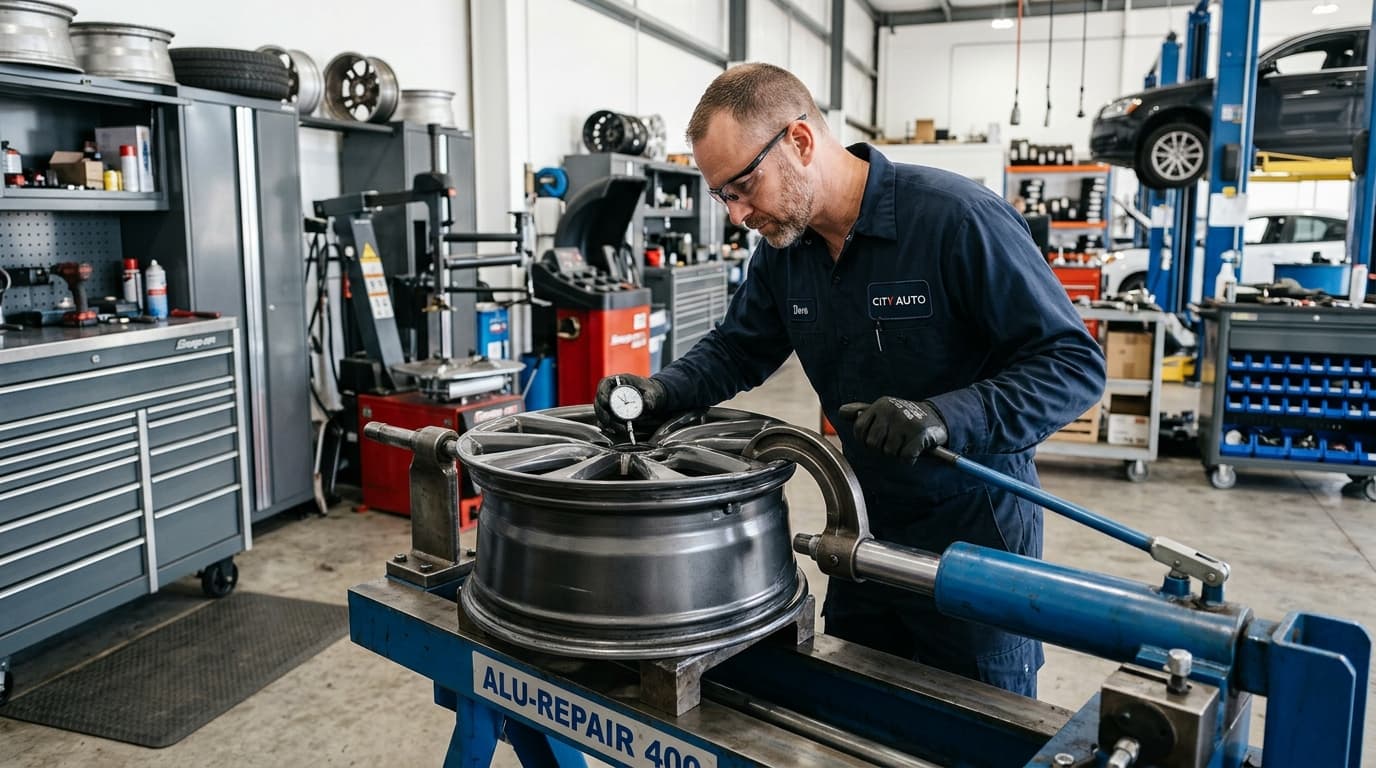
If you've clipped a kerb and folded the outer lip of the rim slightly, this is bread-and-butter wheel repair territory. A hydraulic rim straightener applies controlled pressure to reverse the deformation. When done properly, the repaired rim is structurally sound and the distortion is invisible.
2. Barrel Buckle from Pothole Impact
A buckle in the barrel is more serious, but still commonly repairable. The technician needs to assess the severity and location. A small buckle on the inner barrel of a standard passenger car wheel is usually fine to straighten. A large buckle on a high-performance alloy (think: staggered fitment on a BMW M-Sport or AMG) requires more scrutiny because these wheels run at higher loads and speeds.
3. Older Wheels in Good Overall Condition
If your wheels are structurally sound — no cracks, corrosion is minimal, no previous damage — and the repair is minor, it's almost always worth repairing rather than replacing. A full replacement wheel for many popular cars can run anywhere from R2,500 to R8,000+ per corner. Repair is almost always a fraction of that.
When Should You Replace Instead of Repair?
This is where honest advice matters. Not every bent rim should be repaired, and any reputable wheel specialist will tell you so.
Cracked Wheels Are Non-Negotiable
If your wheel has a crack — even a hairline crack — that's the end of the road for repair. A cracked alloy wheel under load can fail catastrophically. We're talking about sudden loss of tyre pressure at speed, or in extreme cases, a wheel that separates. No responsible shop will patch a cracked alloy and send you back onto the road.
If you're unsure, ask the technician to show you the crack under a light or magnifying glass. At Speedline Mags, we always show customers what we've found before recommending a course of action.
Deep Structural Deformation
If the distortion is severe enough that returning the wheel to proper roundness would require removing too much material or overstressing the alloy in the opposite direction, replacement is safer. This typically occurs with very high-speed impacts or where the wheel has been driven on while flat.
Wheels That Have Been Repaired Multiple Times
Every straightening cycle introduces some residual stress into the metal. Most alloys can safely withstand two or three repairs over their lifetime if the damage was minor each time. But if you're looking at a wheel with multiple repaired sections, the cumulative metal fatigue becomes a real concern — particularly for highway driving.
Safety-Critical Applications
If you're driving a heavily loaded bakkie like a Toyota Hilux or Isuzu D-Max for work, or you regularly carry passengers at speed, your risk tolerance should be lower. Replacing a questionable wheel is cheap relative to the consequences of a blowout on the N2.
Bent Rim Repair Cost in South Africa: 2026 Overview
Bent rim repair cost in South Africa varies depending on the severity of the damage, the type of wheel, and whether any refinishing is required after straightening.
As a general guide for Cape Town workshops in 2026:
- Minor lip repair (no refinishing): R300–R600 per wheel
- Moderate lip or barrel repair with basic refinishing: R600–R1,200 per wheel
- Complex straightening with diamond cut or powder coat refinish: R1,500–R2,500 per wheel
Compare this to replacement costs:
- Standard OEM alloy (VW Polo, Toyota Corolla, Hyundai i20): R2,500–R5,000 each
- BMW or Mercedes OEM alloy: R5,000–R12,000+ each
- Ford Ranger or Hilux alloy: R3,000–R7,000 each
The maths almost always favours repair when the wheel is genuinely repairable. For a BMW 3 Series owner in Durbanville facing a bent lip, paying R800 for a repair versus R7,000 for a replacement OEM rim is an obvious decision.
For more detail on what different repairs typically cost, see our wheel repair cost guide for South Africa.
The Buckled Rim and Tyre Relationship
One thing many drivers miss: a bent rim doesn't just cause vibration. It can also cause your tyre to leak air slowly, particularly if the bead seat (the inner edge where the tyre seals against the rim) is distorted. If you've been topping up one tyre more frequently than the others, a bent bead seat is a common cause.
During a repair assessment, the bead seat gets checked specifically. If it can be restored, the tyre seal will be re-established after straightening. If the bead seat is too badly damaged to seal properly, replacement becomes necessary regardless of the rest of the wheel's condition.
Read more about this in our guide on repairing a wheel with a slow leak.
What the Straightening Process Actually Involves
For customers curious about what actually happens during a bent rim repair, here's the general process used at a proper workshop:
- Wheel removal and cleaning — the tyre is dismounted and the wheel is cleaned so the full extent of damage is visible.
- Damage assessment and runout measurement — the wheel is spun on a jig and the deviation is mapped precisely.
- Hydraulic straightening — the rim is mounted on a specialised straightening machine. Controlled hydraulic pressure is applied incrementally to reverse the distortion. This is not banging a rim back with a hammer — modern wheel straightening machines apply measured, calibrated force.
- Recheck and fine adjustment — the wheel is measured again and the process is repeated until runout is within specification.
- Refinishing if required — if the impact has scuffed or damaged the visible surface of the wheel, refinishing (painting, powder coating, or diamond cutting) is done after straightening.
- Tyre remount and balance — the tyre is fitted back and the assembly is balanced before return.
The whole process for a typical repair takes a few hours to a day, depending on refinishing requirements.
Bent Rim Safety: The Bottom Line
The question we get asked most often is: "Is it safe to drive on a bent rim?" The honest answer is — it depends on how bent.
A very slight distortion (under 1mm runout) may be barely noticeable and poses minimal short-term risk on normal roads. But anything beyond that puts stress on your tyres, causes uneven wear, and increases the risk of tyre failure — especially at speed or in hot conditions. South African summer heat already puts tyres under strain; a compromised rim makes it worse.
Our general advice at Speedline Mags: if you can feel it in your steering or seat, don't delay getting it looked at. A basic assessment takes 20 minutes and will tell you exactly where you stand.
For a broader guide to signs your wheels need professional repair, that post covers the full range of symptoms to watch for.
Bent Rim Repair in Cape Town: Speedline Mags
Speedline Mags is based in Parow, Cape Town, and serves drivers across the Northern Suburbs — from Bellville and Durbanville to Table View and beyond. We handle everything from minor lip repairs on passenger car alloys to complex buckled rim assessments on bakkies and SUVs.
Our process is transparent: we assess first, show you what we've found, and give you an honest recommendation. We won't repair a wheel that shouldn't be repaired, and we won't push replacement when repair is the right call.
If you've hit a pothole and you're not sure what you're dealing with, bring your vehicle in or give us a call. We'll take a look and give you a straight answer — no jargon, no pressure.
Contact Speedline Mags in Parow, Cape Town to book your bent rim assessment or get a repair quote.